

Could an ancient Vedic measure of time have a basis in Earth’s natural cycles? A surprising connection between astronomical periodicities, sea-level changes, and the yugas suggests the possibility may be worth investigating.
The Mystery of the Yugas
In ancient Hindu spirituality and cosmology, time is cyclical. Rather than moving progressively from past to future, worlds pass through repeating ages of creation, development, decline, and renewal.
These ages, known as yugas, are divided into four periods: Satya Yuga (Golden Age), Treta Yuga (Silver Age), Dvapara Yuga (Bronze Age), and Kali Yuga (Iron Age). Together, the four ages form a mahayuga, one complete cycle of time.
According to traditional Vedic astronomy, a mahayuga lasts 4.32 million human years. However, ancient texts such as the Mahabharata and Ramayana contain numerous references to a 12,000 year cycle in which each divine year is equivalent to 360 human years (12,000 x 260 = 4,320,000 years).
What if the original 12,000-year measure had another meaning?
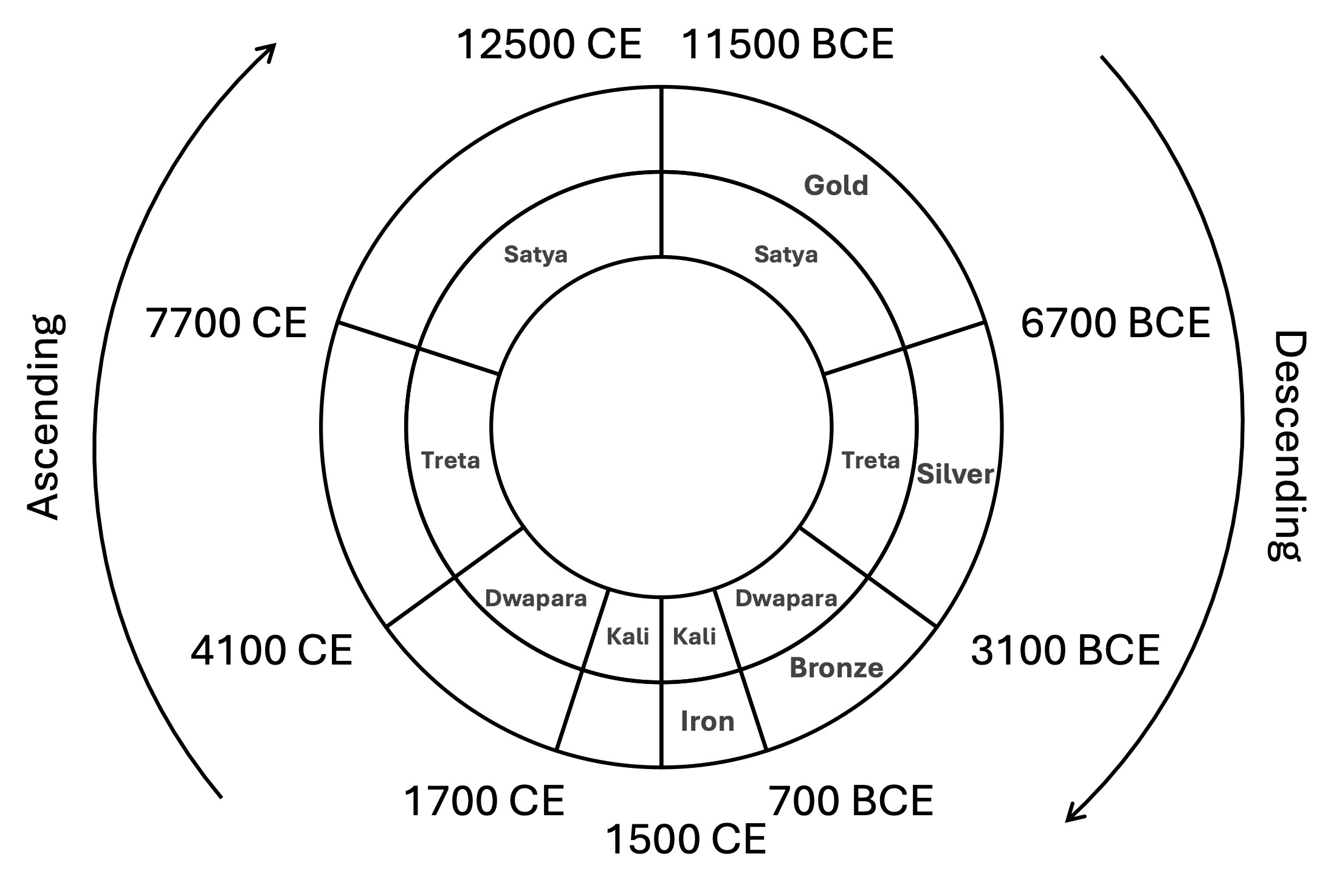
In the late nineteenth century, Indian spiritual teacher Sri Yukteswar Giri in Holy Science proposed that the 12,000 years referred to actual human years. He divided Earth’s approximately 24,000-year precessional cycle into two halves: a descending cycle, when humanity moves from a Golden Age toward a Dark Age, and an ascending cycle, when the process reverses.
Modern astronomy places the precessional period closer to 26,000 years. Although Sri Yukteswar’s interpretation differs from conventional Hindu chronology, the association with precession suggests the yugas might have an astronomical basis.
But could they also have a geophysical one?
Searching for a 12,000-Year Cycle in Nature
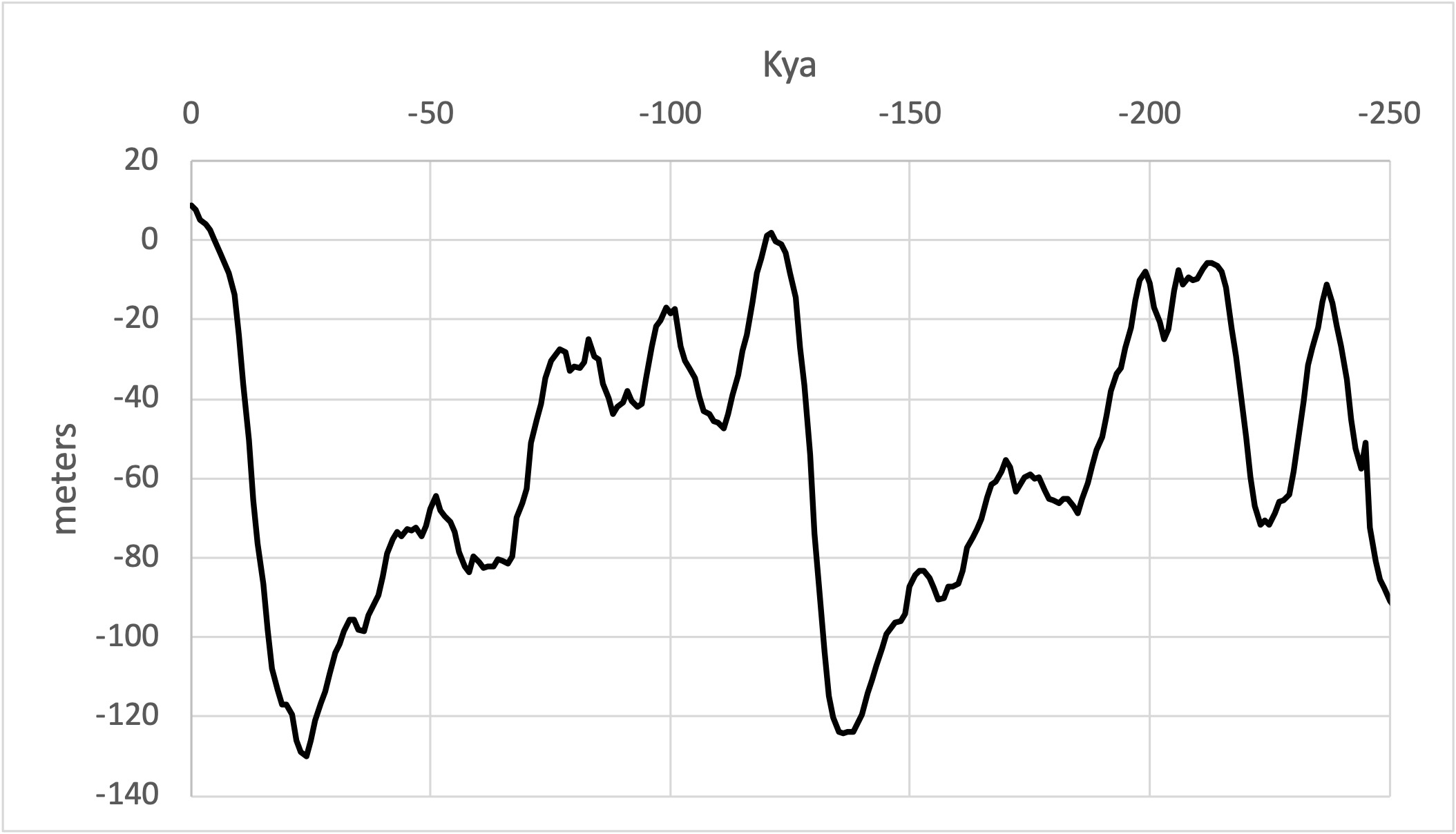
Climate records clearly show the growth and retreat of continental ice sheets over hundreds of thousands of years. One particularly useful indicator or proxy is global sea level. During cold periods, water accumulates in ice sheets, lowering sea levels. During warmer periods, melting ice returns water to the oceans, causing sea levels to rise.
Early in the past century, Milutin Milanković proposed that climate changes are driven by variations in Earth’s orbital eccentricity, axial tilt, and precession, which affect how solar radiation is distributed over Earth’s surface.
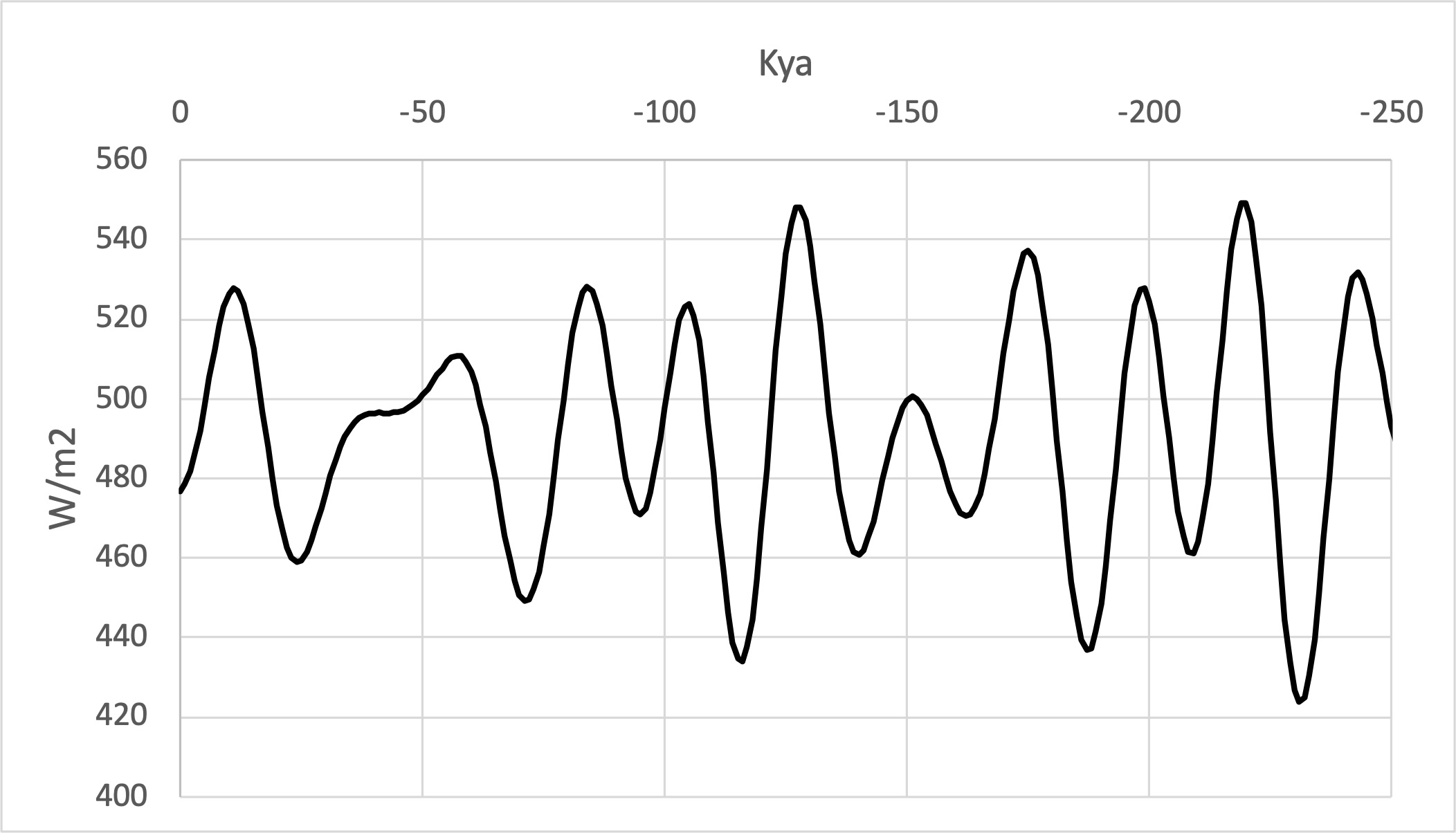
In a study published in 2025, “Yugas, Climate Cycles, and World Ages“, I investigated the possibility that there might be shorter cycles hidden in long-term climate records. I used a method known as Fourier analysis to detect periodicities hidden in time series data. It is widely used in signal processing to separate signals into their underlying frequency components. I applied this approach to two different types of data: calculated solar radiation reaching Earth over hundreds of thousands of years, and changes in global sea-levels derived from paleoclimate evidence.
The results were intriguing.
Analysis of solar insolation indicated 12,000 to 13,000-year cycles over the past 512,000 years. Cycles roughly 5,000, 13,000, and 22,000 years long were found in global sea-level data over the same period. What makes these results interesting is the presence of periodicities near 12,000 years in two different kinds of geophysical data. Combining the power spectral density plots computed for sea-level changes and insolation as shown below reveals two distinct cycles approximately 13,000 and 22,000 years in length.
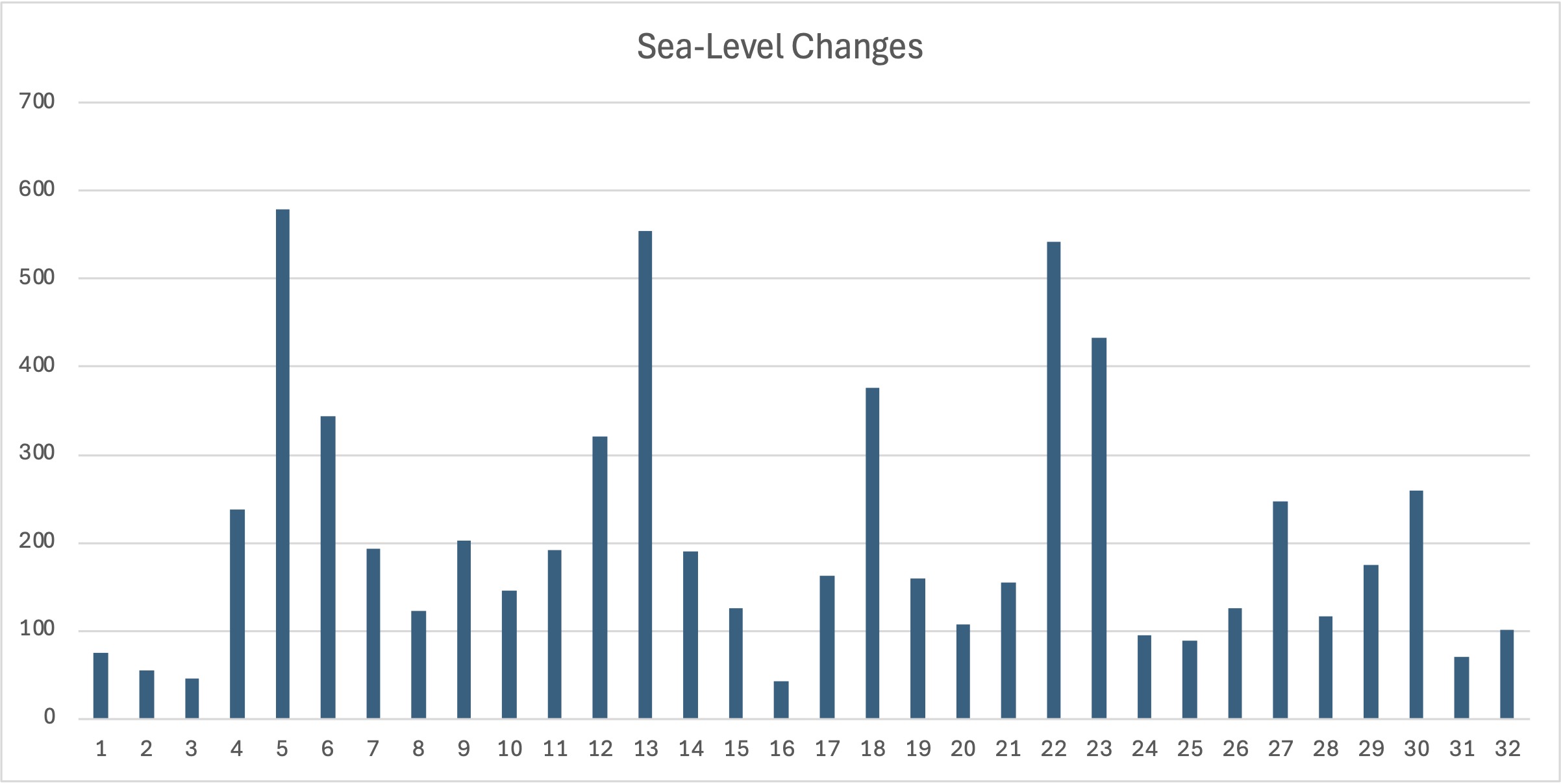
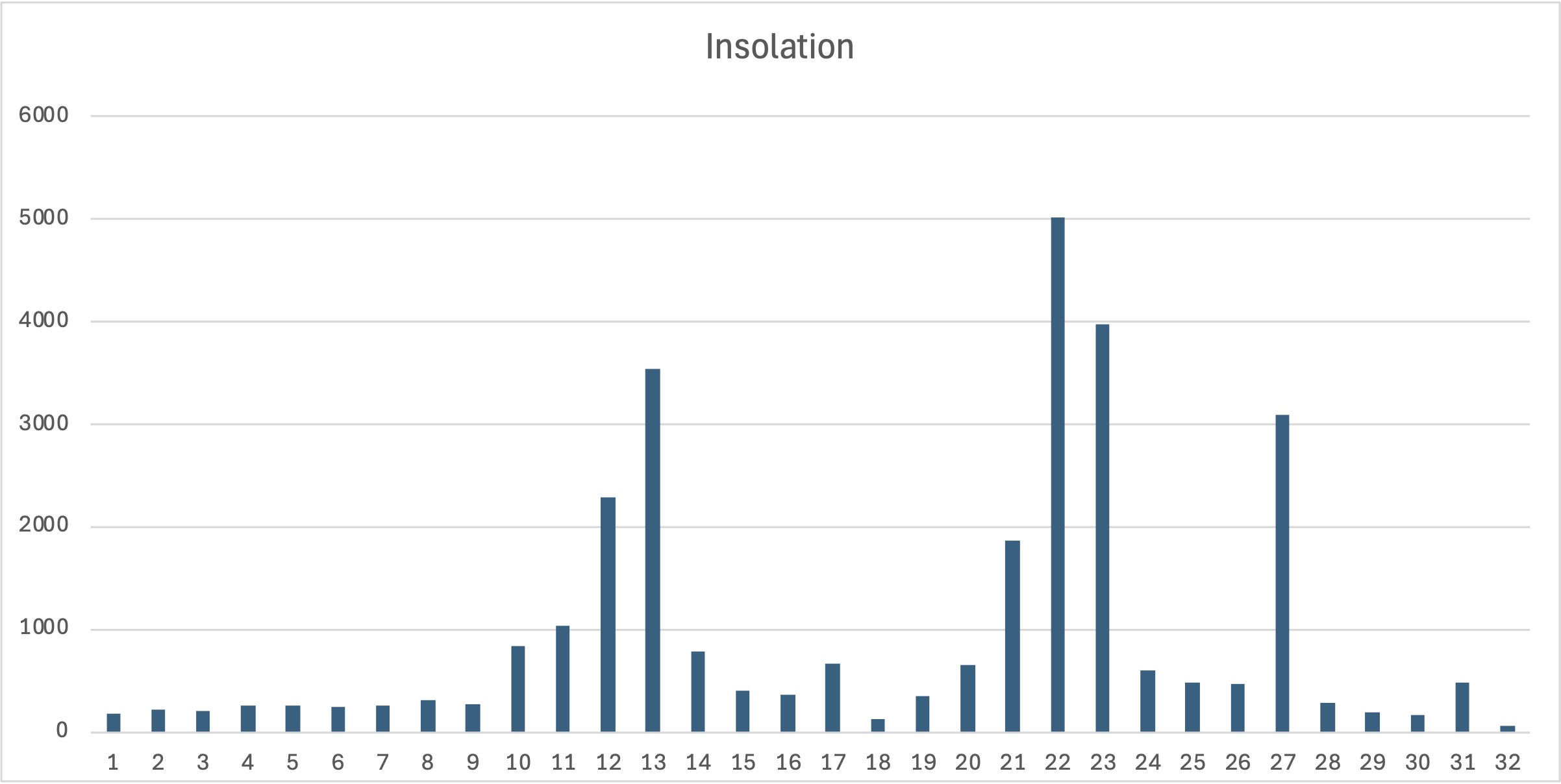
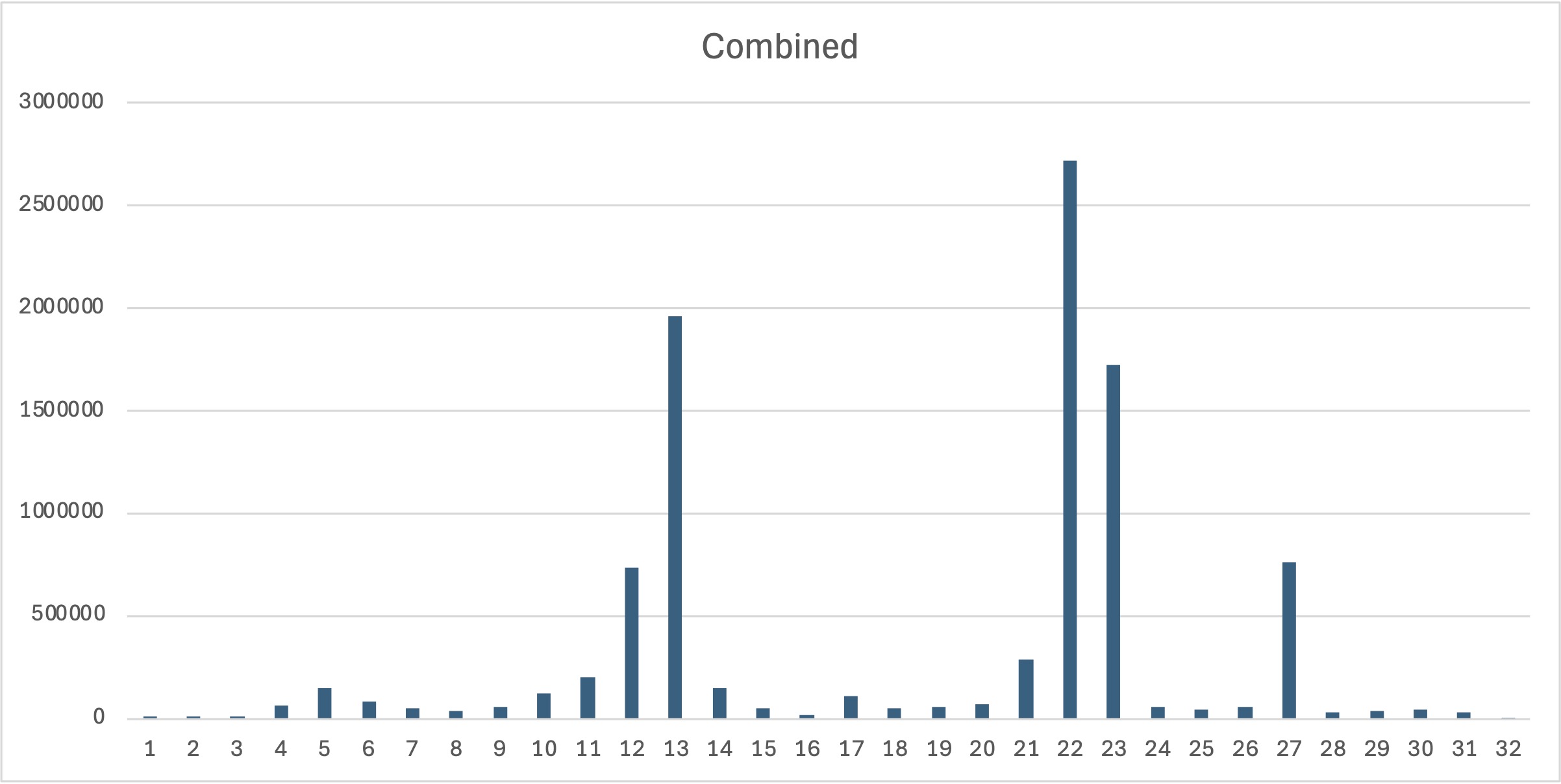
Although my analysis does not prove the existence of a single, stable 12,000-year physical cycle, the coincidence raises an intriguing possibility: If the ancient 12,000-year yuga corresponds to a real timescale associated with changes in Earth’s environment, then 12,000 years might be more than just an arbitrary division of astronomical time.
Do the Yugas Correspond to Events in Earth’s History?
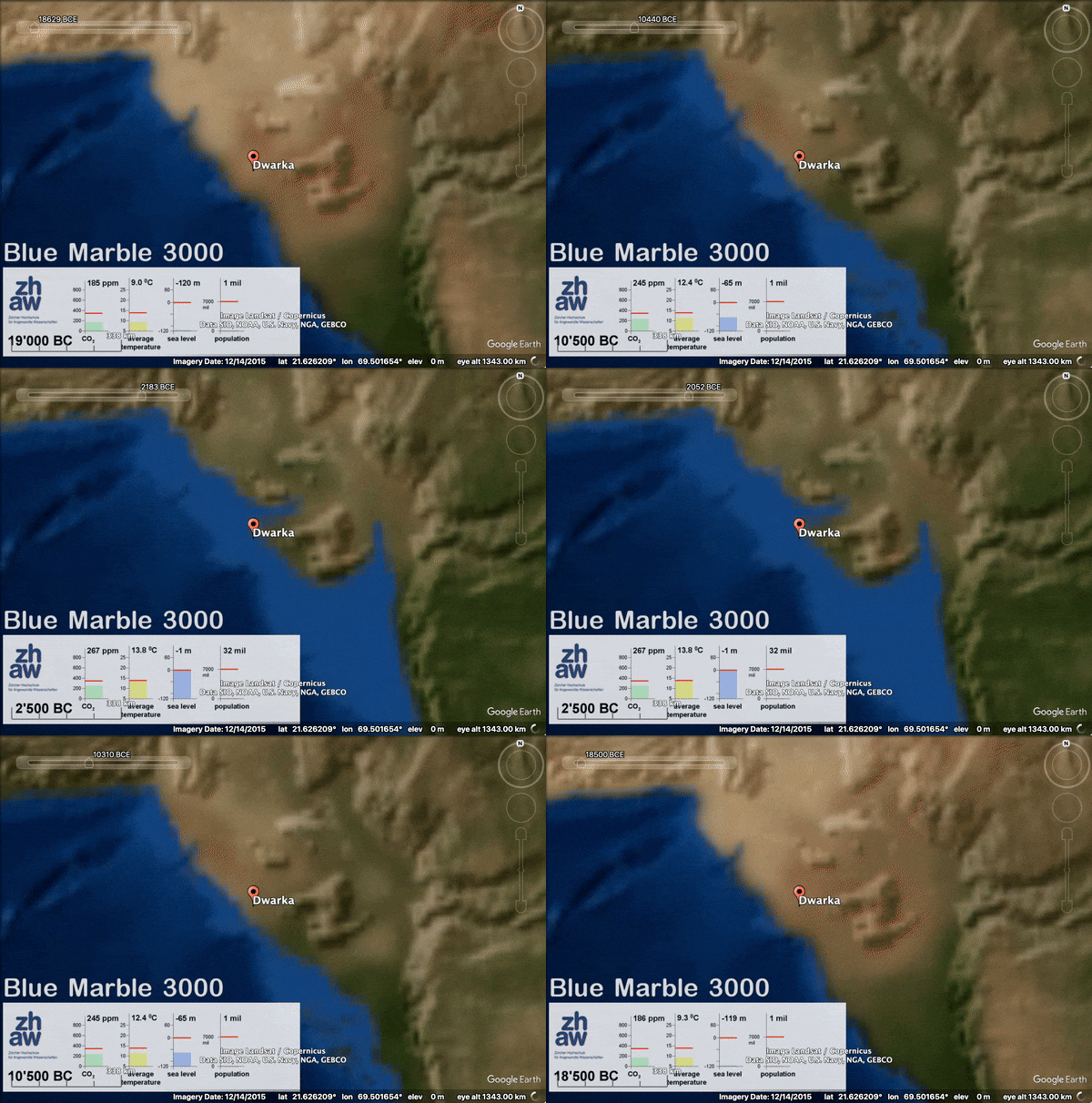
At the end of the last ice age, as continental ice sheets melted and sea levels rose, coastal plains that had been dry land during the last glacial period flooded. If the yugas reflect recurring physical changes, did transitions between ages correspond to major environmental events?
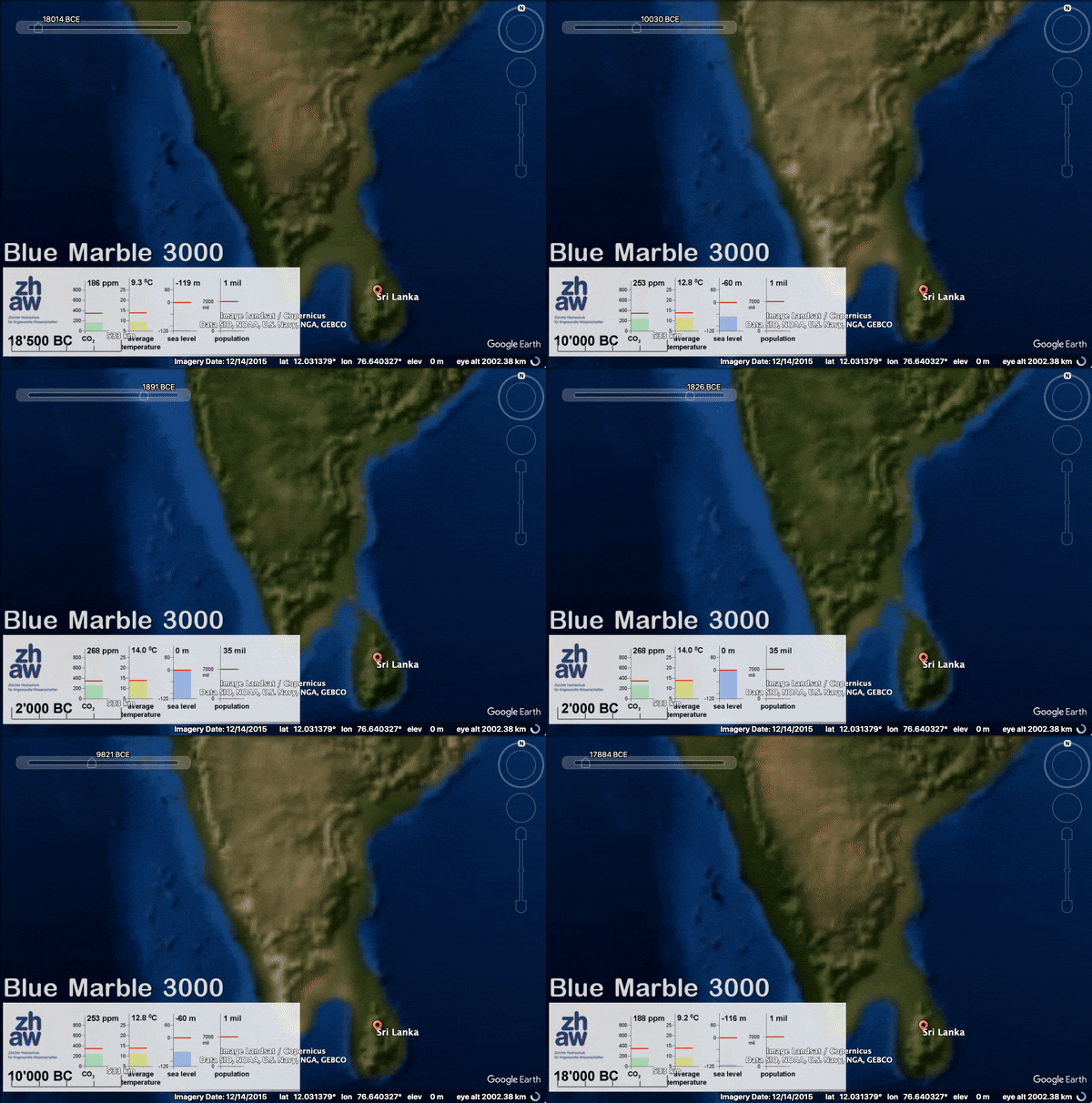
Consider two events mentioned in ancient Indian texts: the flooding of Dwarka, an ancient city on the west coast of India in the Mahabharata, and the crossing from mainland India over a string of islands to Sri Lanka in the Ramayana.
Dwarka
According to the Vishnu Purana, an ancient Vedic text, Dwarka flooded at the end of the Dwapara Yuga (Wilson 1895, pg. 61):
“on the same day that Hari departed from the earth the dark-bodied Kali age descended. The ocean rose and sub-merged the whole of Dwaraka, except alone the dwelling of the deity of the race of Yadu.”
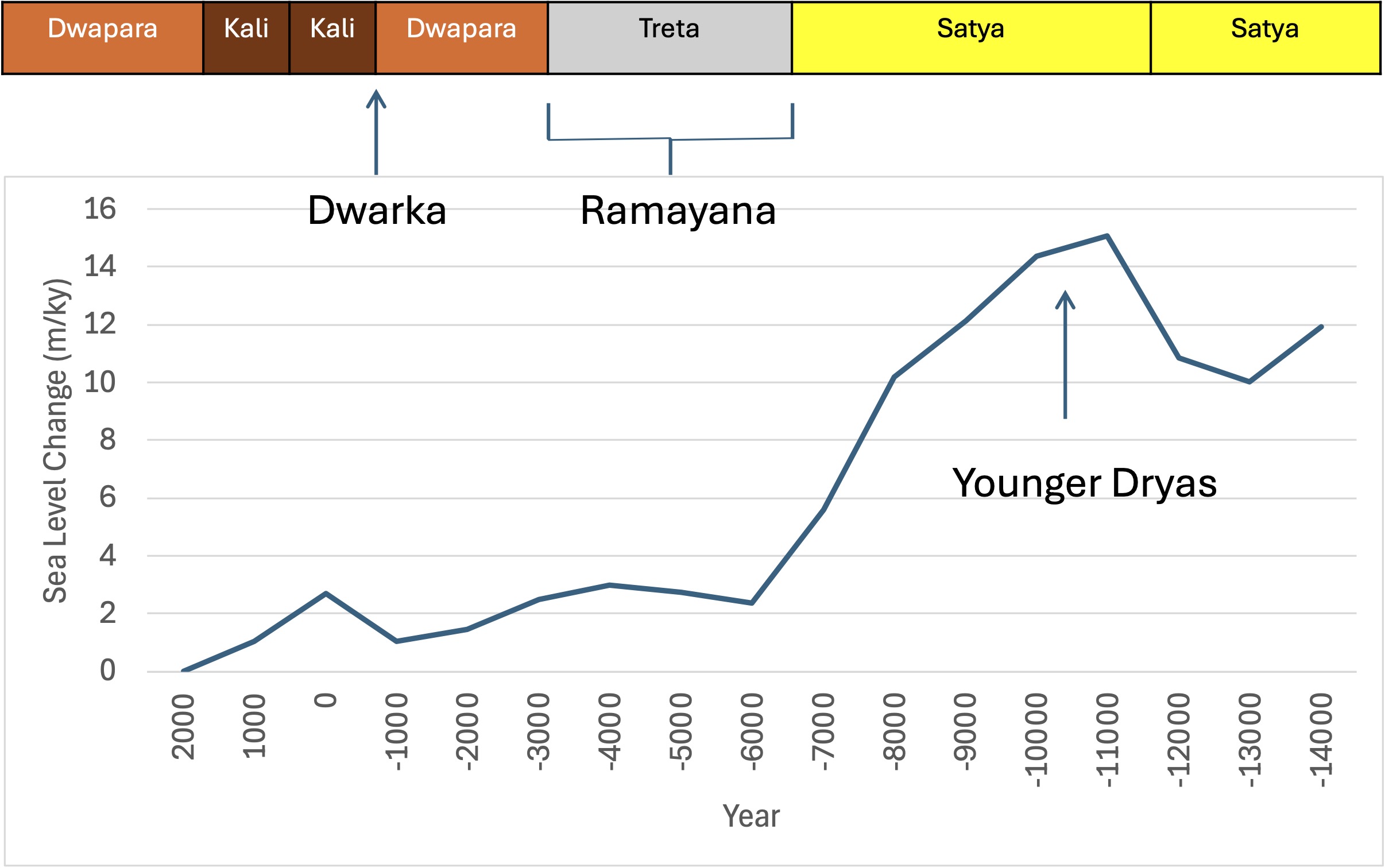
In Sri Yukteswar’s chronology, the beginning of the Kali Yuga occurred around 700 BCE. The flooding of ancient Dwarka, which is portrayed as an Iron Age civilization in the Mahabharata, is fits in well with the accepted timeframe of the Indian Iron Age starting in the first or second millennium BCE. It is also in agreement with S. R. Rao’s discoveries of stratigraphic, ceramic and inscriptional evidence dating submerged ruins to the west of today’s Dwarka to the 14th century BCE.
Sri Lanka
In the ancient Indian epic Ramayana, the demon king Ravana kidnaps Prince Rama’s wife Sita. In Rama’s quest to rescue Sita, he journeys to Lanka (Griffith, 1870, pg. 17):
“A bridge was thrown by Nala o’er the narrow sea from shore to shore. They crossed to Lanká’s golden town, where Ráma’s hand smote Rávan down.”
Global sea-level data indicate Sri Lanka started to become separated from mainland India circa 5500 BCE. With Rama as one of the three avatars of the age, the Ramayana would have taken place during the Treta Yuga, which according to Sri Yukteswar’s chronology would have been sometime between 3100 BCE and 6700 BCE.
Ancient Science or Coincidence?
These comparisons do not establish that the events described in the ancient texts occurred as written. Nor do they independently validate the proposed chronology.
The yugas are usually interpreted in religious, philosophical, or mythological terms. They describe the rise and decline of humanity through a repeating sequence of ages.
But perhaps there is another layer to the tradition.
Analysis of long-term climate records suggests the presence of periodicities broadly comparable to a 12,000-year cycle. Although these findings are preliminary and do not establish a direct connection between Vedic chronology and paleoclimate, they provide a starting point for subsequent investigations that can be pursued using modern scientific methods.
The distinction is important. We do not need to assume that the ancient texts are literally correct in order to investigate whether they contain traces of genuine knowledge about the natural world.
The possibility worth exploring is that the 12,000-year yuga cycle was not simply a mythological number, but a measure of recurring changes in Earth’s environment whose significance has long since been forgotten.
Whether this turns out to be ancient science, an extraordinary coincidence, or something in between remains an open question.
And that is what makes it worth investigating.
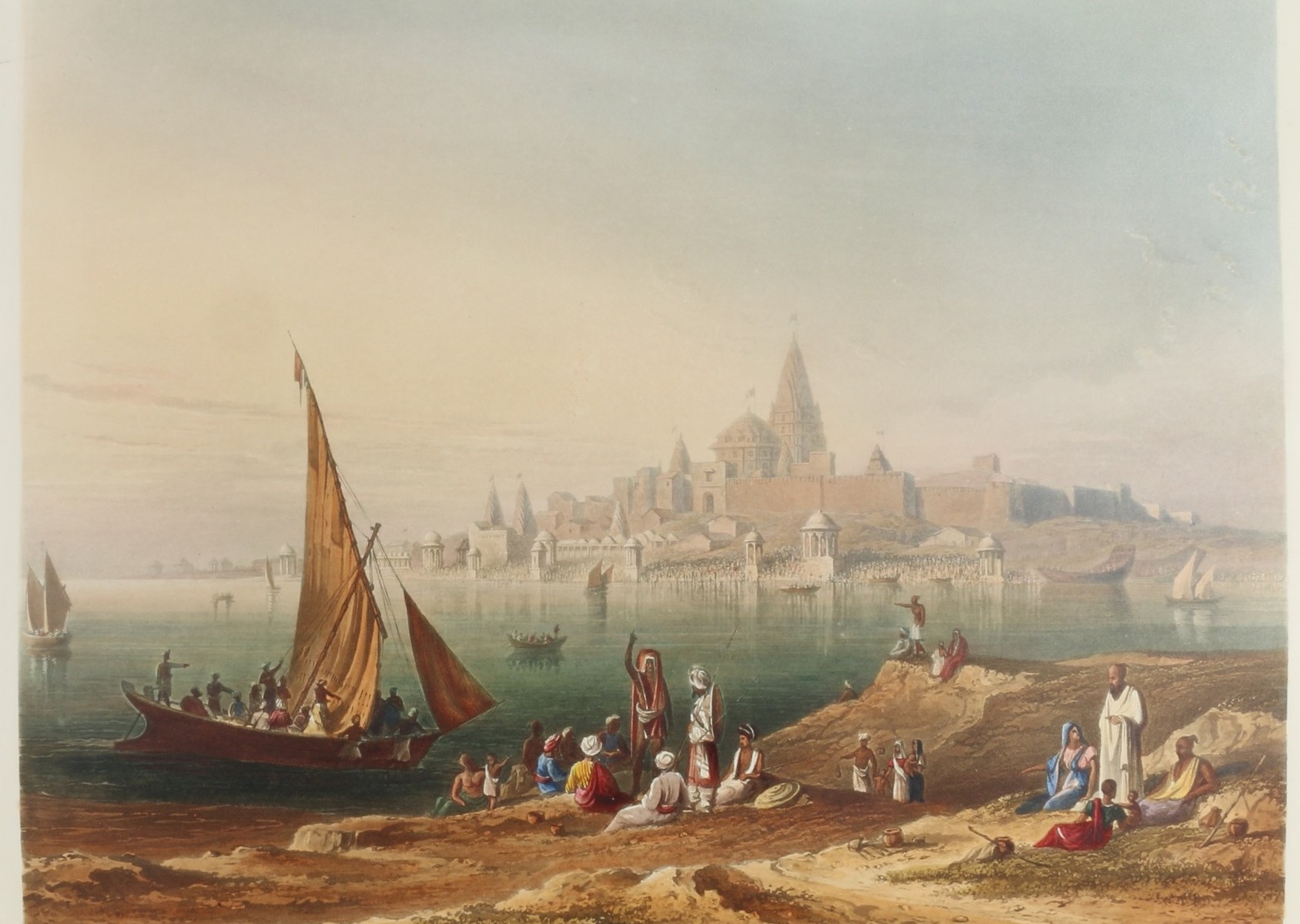
The featured image at the top of the article is a reproduction of The sacred town and temples of Dwarka from Grindlay’s Scenery, Costumes and Architecture chiefly on the Western Side of India, London, 1826-30.
Discover more from Before Atlantis
Subscribe to get the latest posts sent to your email.

