

In Before Atlantis, I presented evidence that advanced civilizations existed throughout the world during the last ice age. My claim was based on over a hundred ancient sites that appeared to point to previous positions of the North Pole. That Earth’s North Pole not only shifted during the last ice age but was responsible for it was a revolutionary idea proposed by Charles Hapgood in his 1958 book Earth’s Shifting Crust. Its publication was somewhat ill-timed in that his theory of crustal displacement was almost immediately dismissed as the emerging theory of plate tectonics, which explained the movement of the continents – an idea first proposed by Alfred Wegener in the early 20th century, was becoming a dominant paradigm in the geosciences. There were also technical problems with his theory, in particular, Hapgood’s contention that crustal displacements were caused by a buildup of ice at the poles, an idea that was later shown to be wrong.
Historically, the geoscience community has rejected crustal displacement theory due to the lack of an identified physical process that can shift the crust thousands of miles in relatively short periods of time. The situation is not unlike Wegener’s theory of continental drift. In 1912, Alfred Wegener proposed that continents were once joined in a supercontinent called Pangaea and have since drifted apart. While he gathered compelling geological, fossil, and climatic evidence, his theory was rejected by many scientists because he could not explain how the continents moved. In the 1960s, Harry Hess proposed the idea of seafloor spreading, where new ocean crust forms at mid-ocean ridges and pushes older crust away. This process gave a mechanism that could move continents, supporting Wegener’s idea.
Long thought to be a theory lacking a plausible mechanism, my latest book, An Inconvenient Theory, explains crustal displacements within the context of existing theories in the geosciences, specifically that changes deep within the Earth can cause the crust at certain times to become “unlocked” from the mantle allowing Earth-Sun-Moon tidal forces, the same forces that move Earth’s oceans, to move its crust. This newly revised and expanded theory of Earth crustal displacement goes beyond the scope of Hapgood’s original theory in that it connects past poles not only with glacial cycles/ice ages but with what could have been past ages of humanity and offers new hypotheses concerning human history.
In the next three articles, I will highlight how this new theory solves key problems in climate science, paleontology, and archaeology including:
- Glacial cycles/ice ages – How massive amounts of ice can melt when global temperatures are coldest at the end of an ice age
- Extreme late Pleistocene climate changes and mass extinctions – The presence of woolly mammoths from northern Mexico to above the Arctic circle, the Hippopotamus and other sub-tropical animals at one time in Britain, and Arctic fox and other animals native to polar climates at another time in Britain, and a paleolake in the middle of the Arabian desert, all within the past 130,000 years
- Unexplained sites – Why the majority of archaeological sites, including the most enigmatic places in the world, are not aligned in any known direction.
The first article summarizes fundamental problems that current theories cannot explain. These problems or anomalies drive the scientific process of coming up with new hypotheses, experiments, and ultimately a new theory, which is discussed in the second article. The third article in the series proposes possible mechanisms behind crustal displacements.
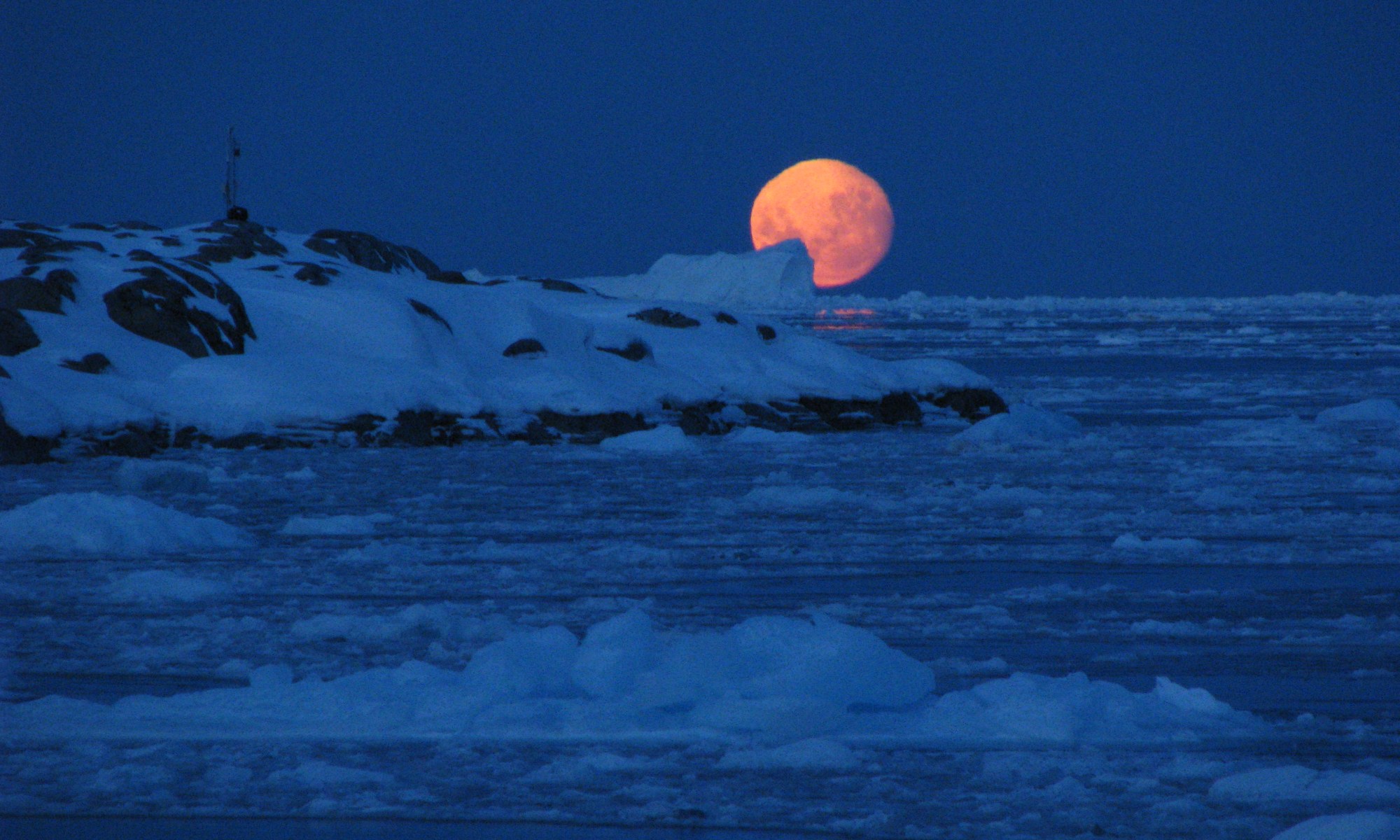
Featured image at the top of the article: “The moon sets behind Bonaparte Point, Anvers Island, across from Palmer Station, the U.S. Antarctic Program’s smallest research station.” September 2, 2009. Courtesy Ken Keenan/Creative Commons CC BY-NC-ND 4.0.
Discover more from Before Atlantis
Subscribe to get the latest posts sent to your email.

