An Analysis of Certain Alignments at Chimalacatlán

In this article, we examine the alignments of certain structures at Chimalacatlán that suggest it might be the oldest archaeological site in Mesoamerica.

Buried Cities, Forgotten Gods

William Niven was a geologist and mineralogist who lived and worked in Mexico for more than five decades beginning in the late 19th century. Niven is perhaps best known for the clay tablets that he discovered in the 1920s, which were later popularized by James Churchward in his theory of a lost continent in the middle of the Pacific Ocean. Less known were Niven’s explorations three decades earlier in the Mexican state of Guerrero.

While on a trip prospecting for a particular garnet known to exist in this part of Mexico, Niven learned of a ruined city in the mountains that had been discovered by Don Lorenzo Castro a few years earlier. After an unsuccessful attempt to reach the area in 1891 Niven returned a year and a half later to find

“Broken walls, ruined buildings, huge in size beyond comprehension… marked the slopes as far as the eye could reach. Once this was a rolling plateau, dropping gently away from the mountain wall, but now it is cut into giant ridges by gorges from 200 to 1,000 feet deep – gorges whose sides are scarred with broken buildings, ridges covered with ruins of great houses…” [1]

Chimalacatlán

It is likely that some of the ruins Niven saw are those located near the town of Chimalacatlán. In “Lost Cities of the Mexican Highlands,” Marco Vigato compares the ruins in Chimalacatlán to those in South America

“Unlike the Andean region of South America, with its impressive megalithic architecture as in the region of Cuzco, capital of the Inca empire, and Tiwanaku, nothing on the scale of the impressive megalithic walls and constructions of Peru seems to have ever characterized Mesoamerican architecture. There is however one remarkable exception to this rule, which is as impressive in its monumentality and scale as it is also remarkably unknown to the public at large, including many of the very specialists in Mesoamerican archaeology and architecture. This is the case of the megalithic platforms and walls of Chimalacatlán, in the south of Morelos and near the border with the state of Guerrero.”

Vigato characterizes the archaeological site, which  is several kilometers southwest of the town of Chimalacatlán, as  “a set of dry stone platforms, placed at different levels, once connected through a system of monumental ramps and stairway” that form “a set of plazas at different levels, roughly following the profile of the natural elevation.”

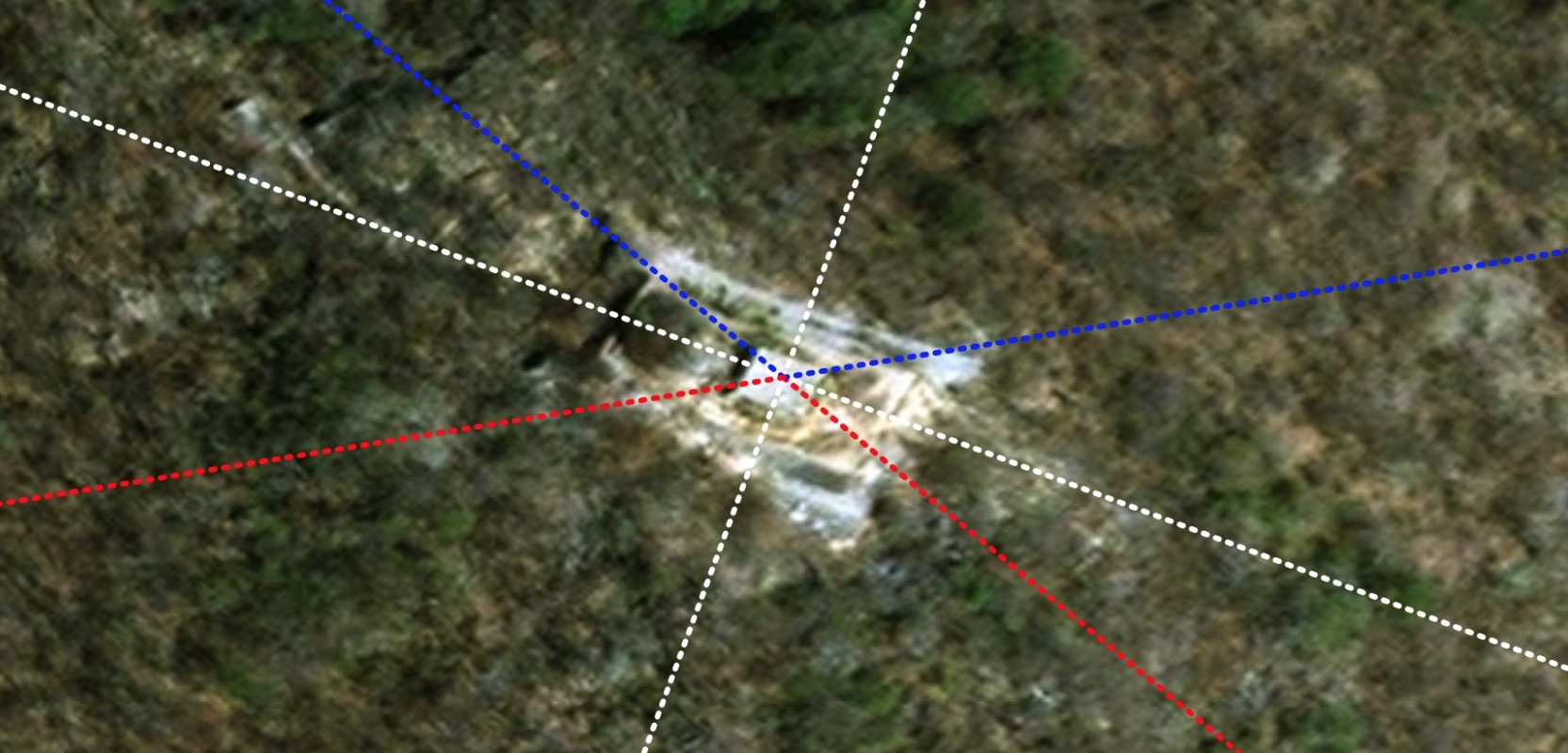
Figure 1 Locations of three structures in the mountains southwest of Chimalacatlán that are discussed in this article. Chimalacatlán is the small town at the top of the image.

Three structures are visible in Google Earth imagery. C1 is a “megalithic acropolis” consisting of two stone platforms each about 30×30 meters in area whose “outer walls reach at least 7 to 8 meters high at the northwest corner and are entirely built of massive ashlars, some of which over 2.5 meters long. The construction is of remarkable quality and accuracy, consisting of several layers of carefully laid out and jointed megalithic stone blocks.” [2]
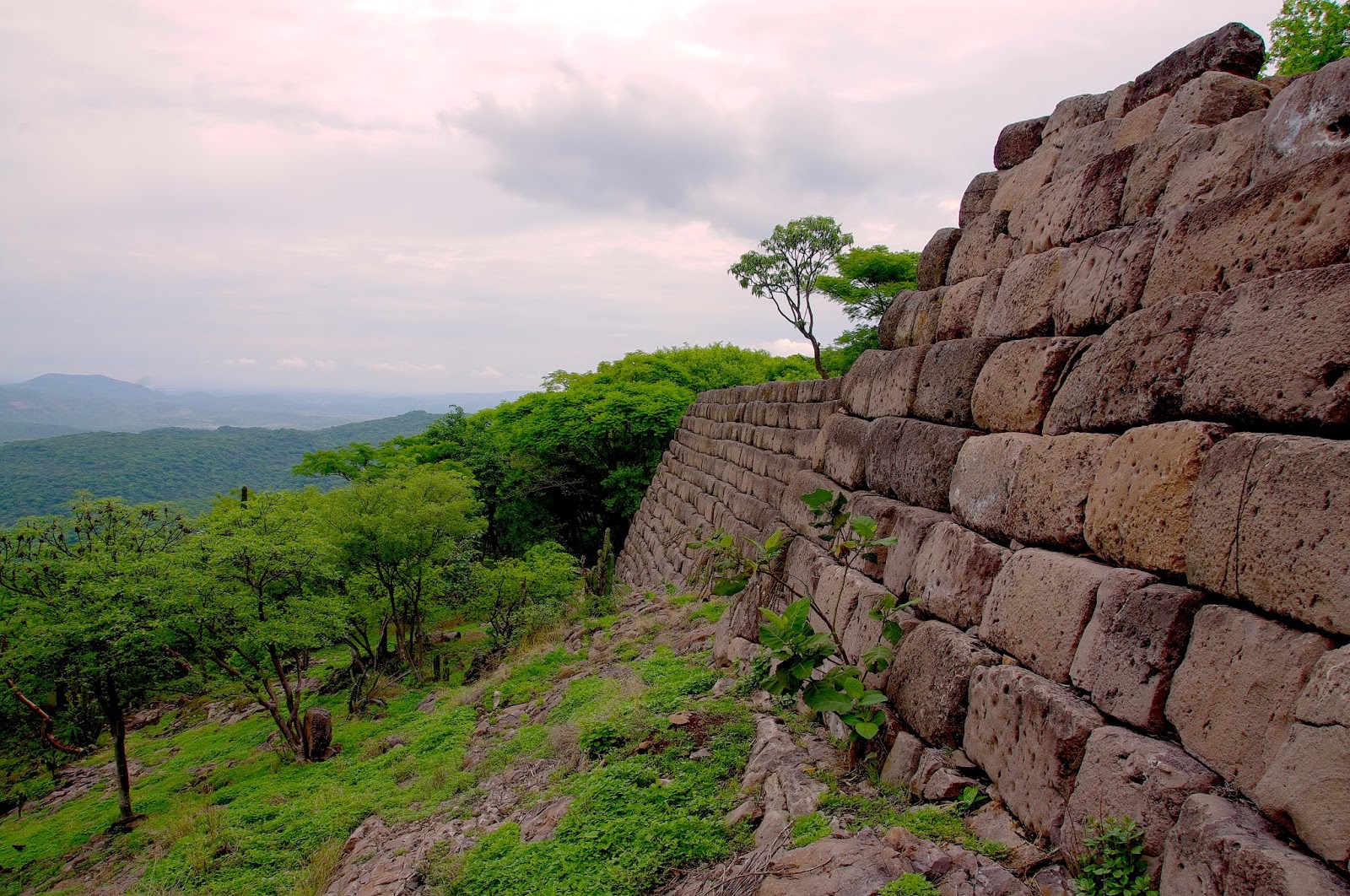
Figure 2 Southwestern side of structure C1.  Image courtesy Marco Vigato

C2 is at the summit of Cerro del Venado. Vigato describes the structure as being pyramid-like in appearance, “consisting of four super-imposed terraces, all sharing the same trapezoid shape with the exception of the top platform, which is a perfect square. Although some larger stones were employed in the construction of this pyramid, and a few well-cut stone blocks are visible on some of the terraces, the workmanship is generally poorer than the rest of the megalithic platforms, employing smaller and more irregular stones.” [2]
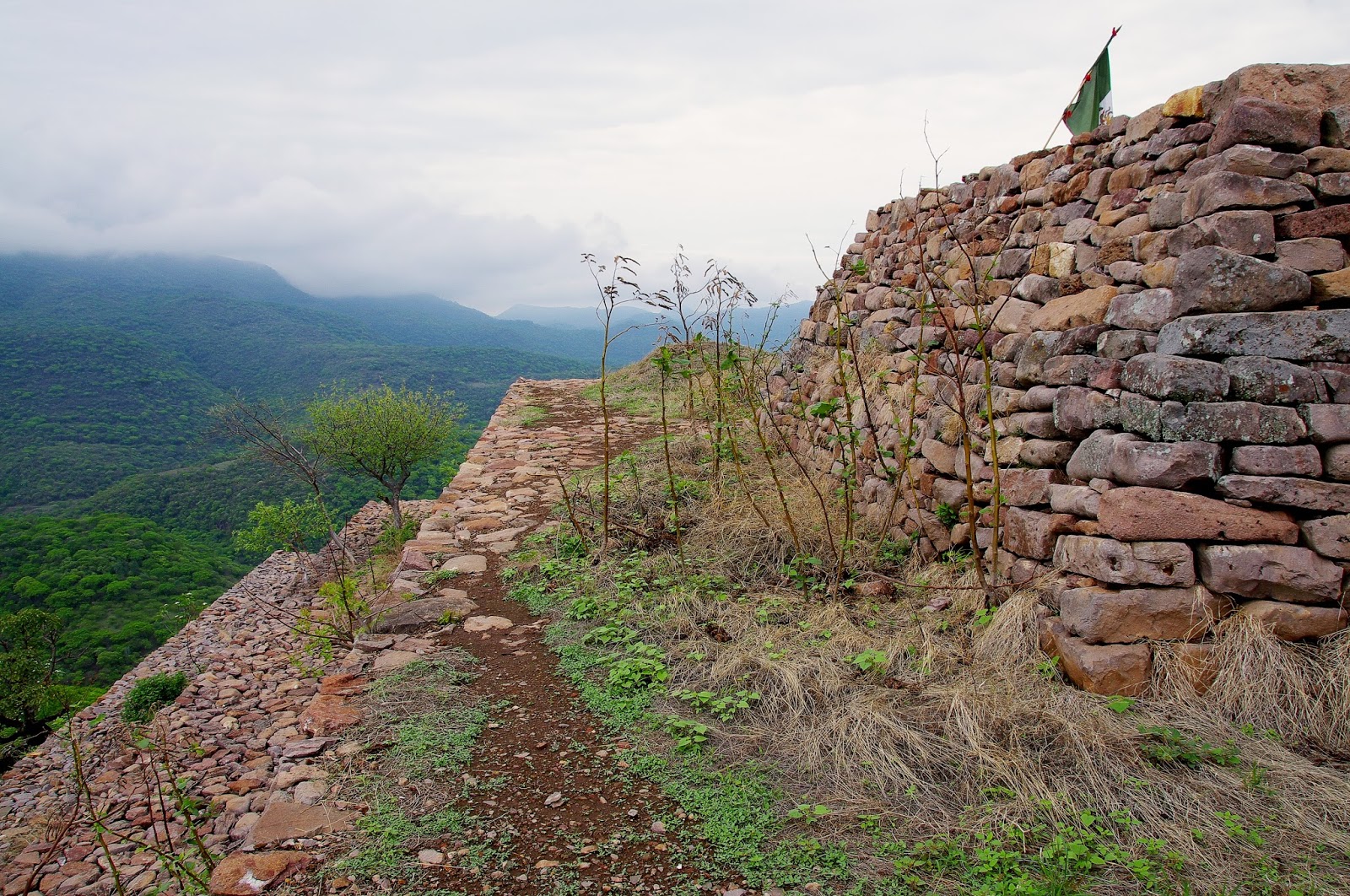
Figure 3 Northeastern side of structure C2. Image courtesy Marco Vigato.

C3 is on the Mesa del Venado near the entrance to the site. The walls of the structure are composed of mid-sized, roughly cut stones and are the least sophisticated in terms of the size and shape of the stones used suggesting the possibility that it was a later addition to the site.
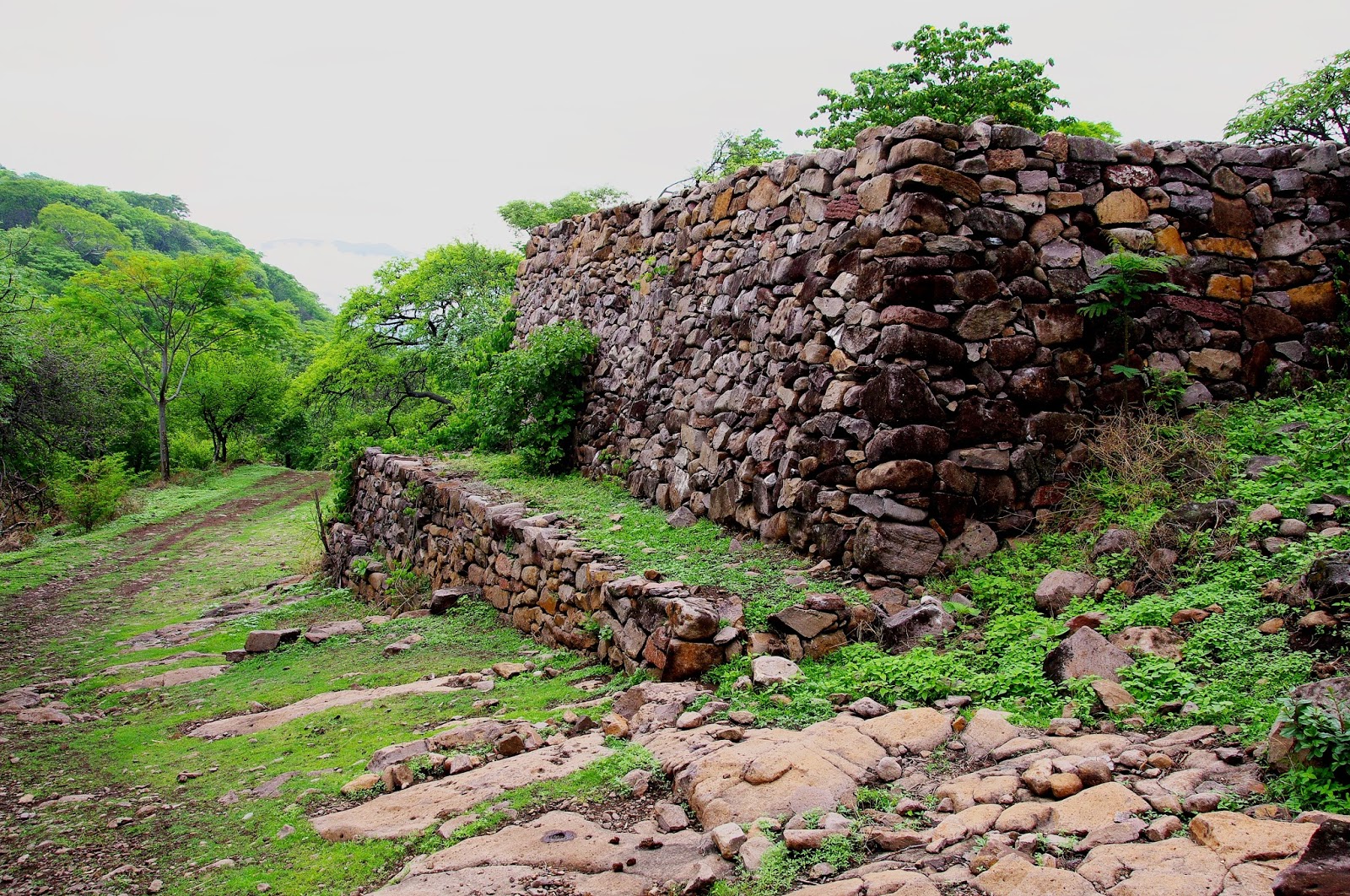
Figure 4 One of the sides of structure C3. Image courtesy Marco Vigato.

Many have speculated that these ruins might be the remains of a mythical place called Tamoanchan, considered to be the cradle of all Mesoamerican civilizations. Is there a way to date Chimalacatlán based on the alignments of these structures?

Ancient Alignments

As discussed in Before Atlantis numerous sites in Mexico appear to have been aligned to ancient poles that are hypothesized to have once existed in Hudson Bay, Greenland, and the Norway Sea. For example, Teotihuacan is aligned to Hudson Bay, which based on current climate data could have been the location of the North Pole prior to the end of the last ice age, approximately 12,000 to 18,000 years ago. Tenochtitlan (today’s Mexico City) and Chichen Itza are aligned to locations in northern Greenland and the Norway Sea that could have been the locations of the North Pole at earlier climate epochs as far back as 75,000 years ago. By virtue of the alignments of these sites to older poles, we hypothesize that the sites are as old as poles.

Places in South America such as Cuzco and sites in Peru’s Sacred Valley and in other parts of the world appear to be aligned to an even older pole located north of the Aleutian Islands in the Bering Sea. Up to this point, no site in Mesoamerica had been found to be aligned in the direction of the Bering Sea pole, implying that Mesoamerica was not settled until after the Bering Sea to Norway Sea pole shift, which is estimated to have occurred about 125,000 years ago.

At Machu Picchu, the Temple of the Three Windows lines up with the Bering Sea pole. Similarly, at Ollantaytambo, the Wall of the Six Monoliths also faces that direction. Smaller less sophisticated structures at these sites are aligned in other directions. Figure 5 reveals that the megalithic acropolis at Chimalacatlán, the structure we call C1 is also aligned to the Bering Sea pole.
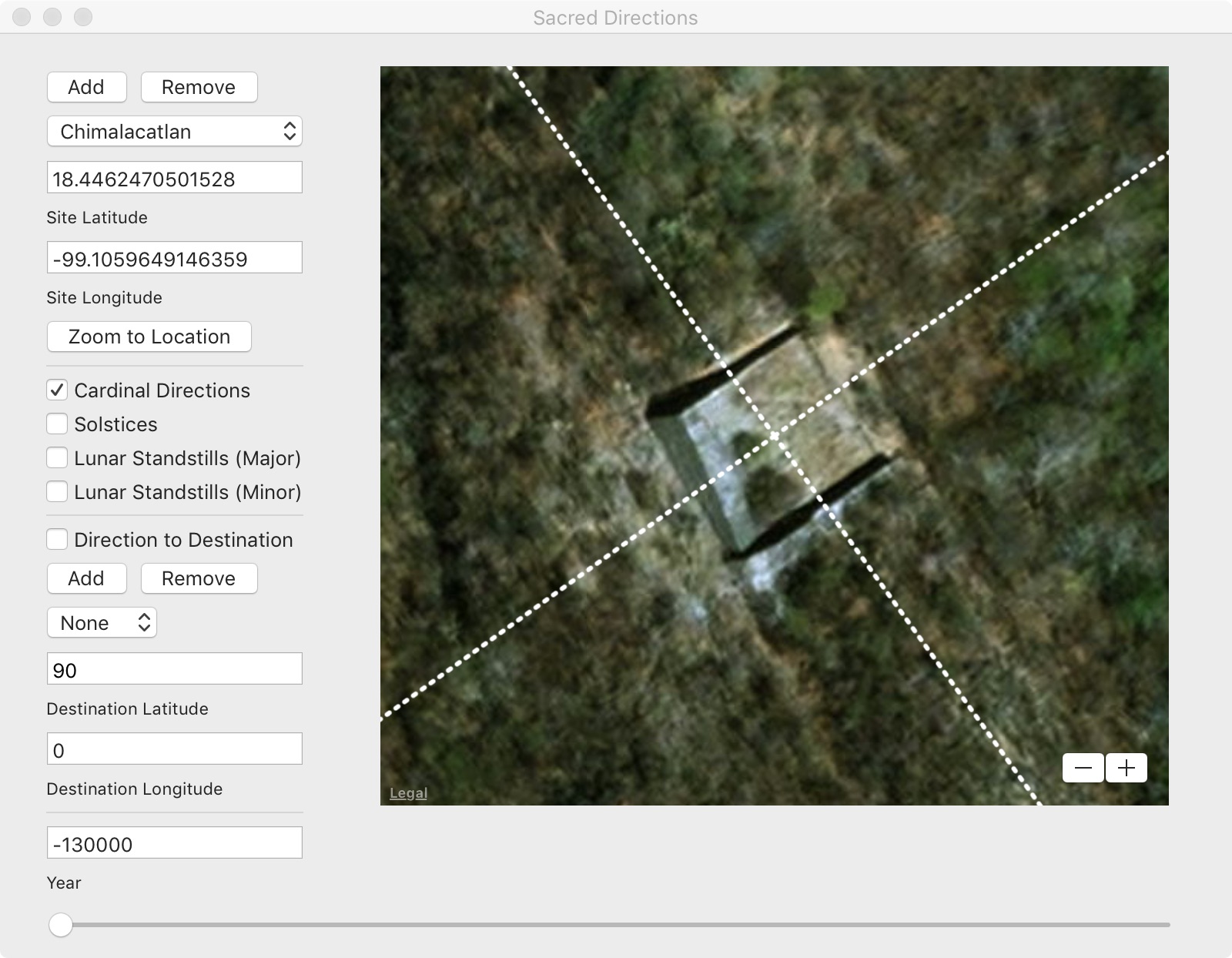
Figure 5 Alignment of structure C1 to the Bering Sea Pole.

C2, the pyramidal structure uphill from C1 also references the Bering Sea pole but in another way. Where C1 would have been oriented to the cardinal directions relative to the Bering Sea pole, i.e., to the sunrise on the equinox, C2 would have faced the most northern direction of moonrise and most southern direction of moonset  (Figure 6). The alignment of C3 is less clear but could have also been oriented to the moon at this time.

Figure 6 Structure C2 would have been aligned to major lunar standstills when the North Pole was in the Bering Sea.

Other Alignments

Using the Sacred Directions archaeoastronomy app it is possible to quickly assess other alignment possibilities. For example, moving the time slider forward in time to after the Bering Sea to Norway Sea pole shift, C2 became aligned both to the sun and the moon (Figure 7). This suggests the possibility that C2 could have been added later.

Figure 7 After the Bering Sea to Norway Sea pole shift C2 would have faced north with the diagonals of the top rectangular structure aligned to major lunar standstills.

Moving the time slider to the present time reveals a less ancient but equally plausible explanation in which all three structures line up to major lunar standstills. Perhaps like other sites such as Chan Chan in Peru that might have once faced an ancient north pole and were later repurposed as lunar sites after subsequent pole shifts, the same could be true for Chimalacatlán. If so,  evidence that the ancient people here worshipped the moon might be found in artifacts, iconography, or other sources of information. Otherwise, the possibility exists that the ruins at Chimalacatlán might be as old as those in Peru based on similarity in construction materials, technique, and alignment, and so could have been the first settlement in Mesoamerica.

In an article [3] published in 1896 by The American Antiquarian and Oriental Journal, Niven reported that ruins could be found in every foot-hill and mountain ridge over an area in excess of 900 square miles in this part of Mexico. If Chimalacatlán were once a part of Tamoanchan perhaps other sites can be found and analyzed in this context.

References

[1] Robert S. Wicks and Roland H. Harrison, Buried Cities, Forgotten Gods: William Niven’s Life of Discovery and Revolution in Mexico and the American Southwest, Texas Tech University Press, 1999.

[2] Marco Vigato,  “Lost Cities of the Mexican Highlands,” Uncharted Ruins.

[3] “Remarkable Discovery of the Ruins of a Prehistoric City in Mexico,” The American Antiquarian and Oriental Journal Vols. 18-19, 1896.



Lunar Temples

We return to earth after our brief visit to the moon in the past couple of articles and examine sites that are aligned to the moon. 

Most people are familiar with the seasonal path of the sun – that it rises in the east and sets in the west, more or less. The motion of the moon, however, is more complex and perhaps, as a result, is seen as being more mysterious. (Professor Judith Young provides a nice explanation in her article Moon Teachings for the Masses.)

In this article, with the help of a newly developed archaeoastronomy app, we review sites from around the world that are aligned to the moon.

Britain

We start in Britain the home of Stonehenge, one of the most famous and enigmatic of all ancient sites. Although it is generally known when it was built, around 3100 BCE, no one knows exactly why it was built or by whom.

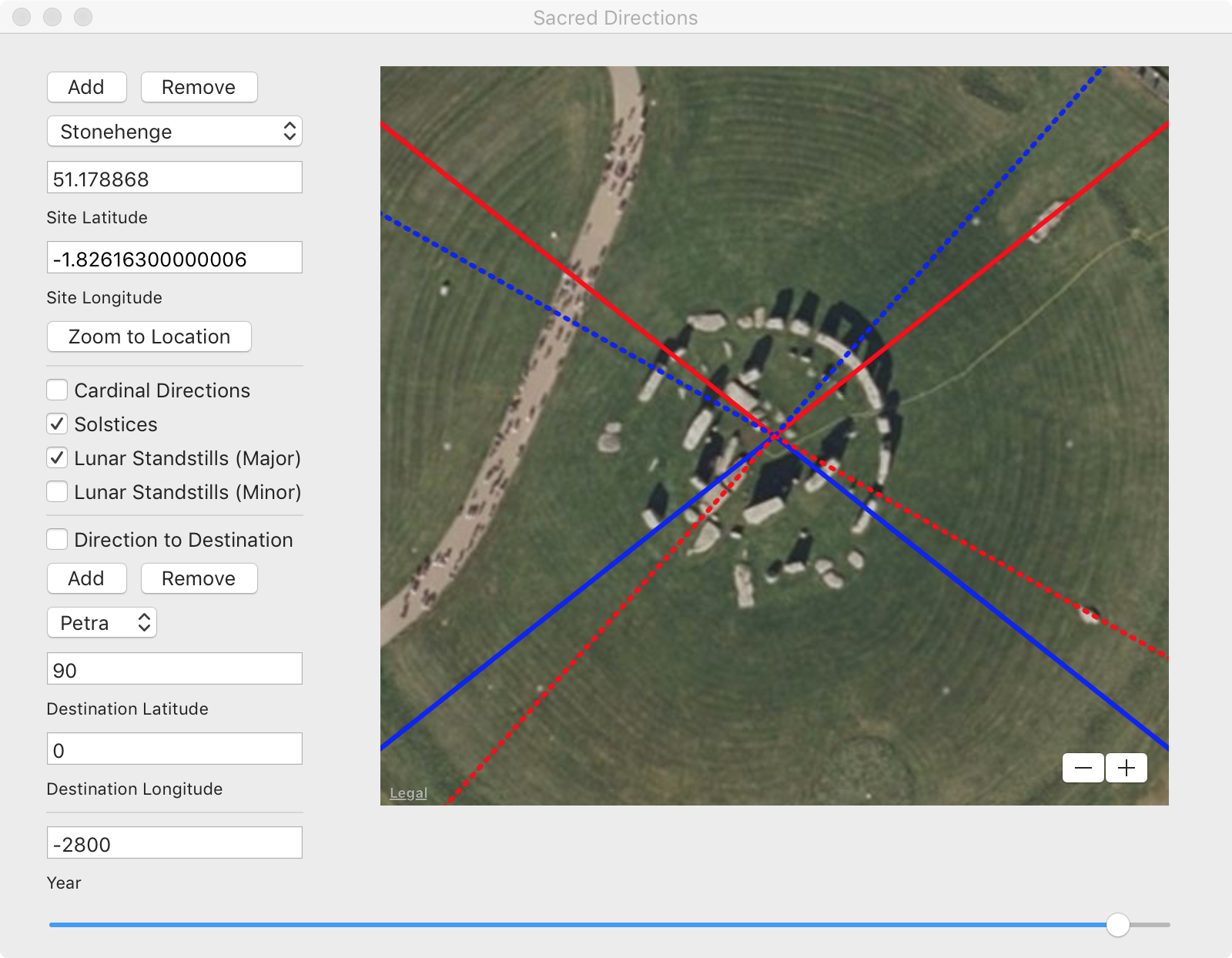
Around 2600 BCE a large stone known as the Heel Stone was added outside of the inner circle of stones and positioned so as to line up with the summer solstice sunrise when it is viewed from the center of the site. At the same time, four other outlying stones called Station Stones were arranged to form a rectangle around the central monument. One of the Station Stones was positioned in the direction of maximum southern moonrise, also called a major lunar standstill. Today, these alignments are off by about a degree due to the change in earth’s obliquity since the time they were set into place more than 4000 years ago.

Figure 1 Alignments at Stonehenge. Solstices are depicted as solid lines and lunar standstills as dotted lines. Time slider shows the direction of the alignments around 2600 BCE.

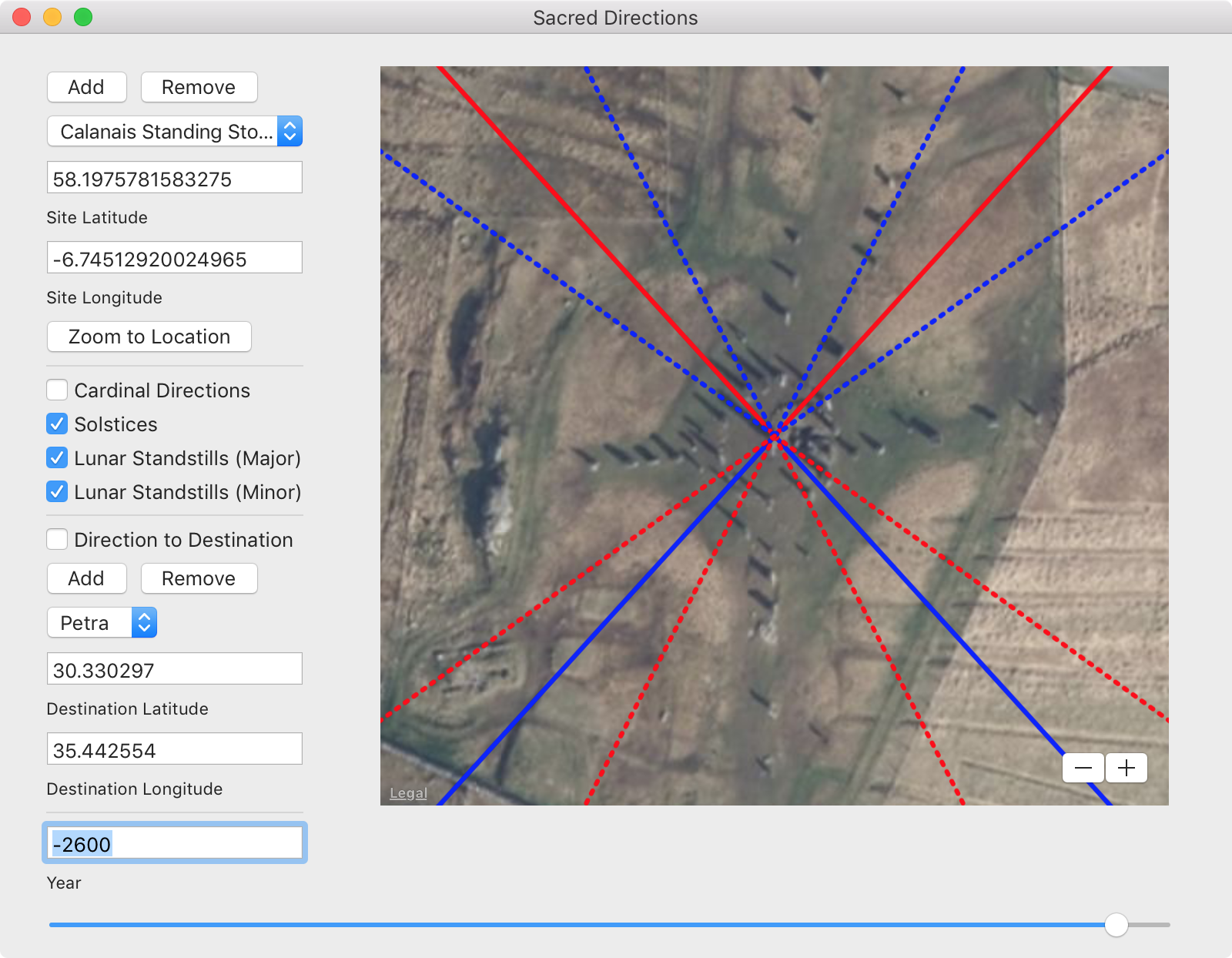
There are other sites in Britain that also appear to reference the motion of the moon. The Calanais Stones are in the Outer Hebrides in Scotland. The circle of stones, which is thought to have been set in place between 2600 and 2800 BCE has been interpreted by several researchers to have been used as a lunar observatory.

Figure 2 Alignments at Calanais around the same time as Stonehenge (2600 BCE).

Middle East

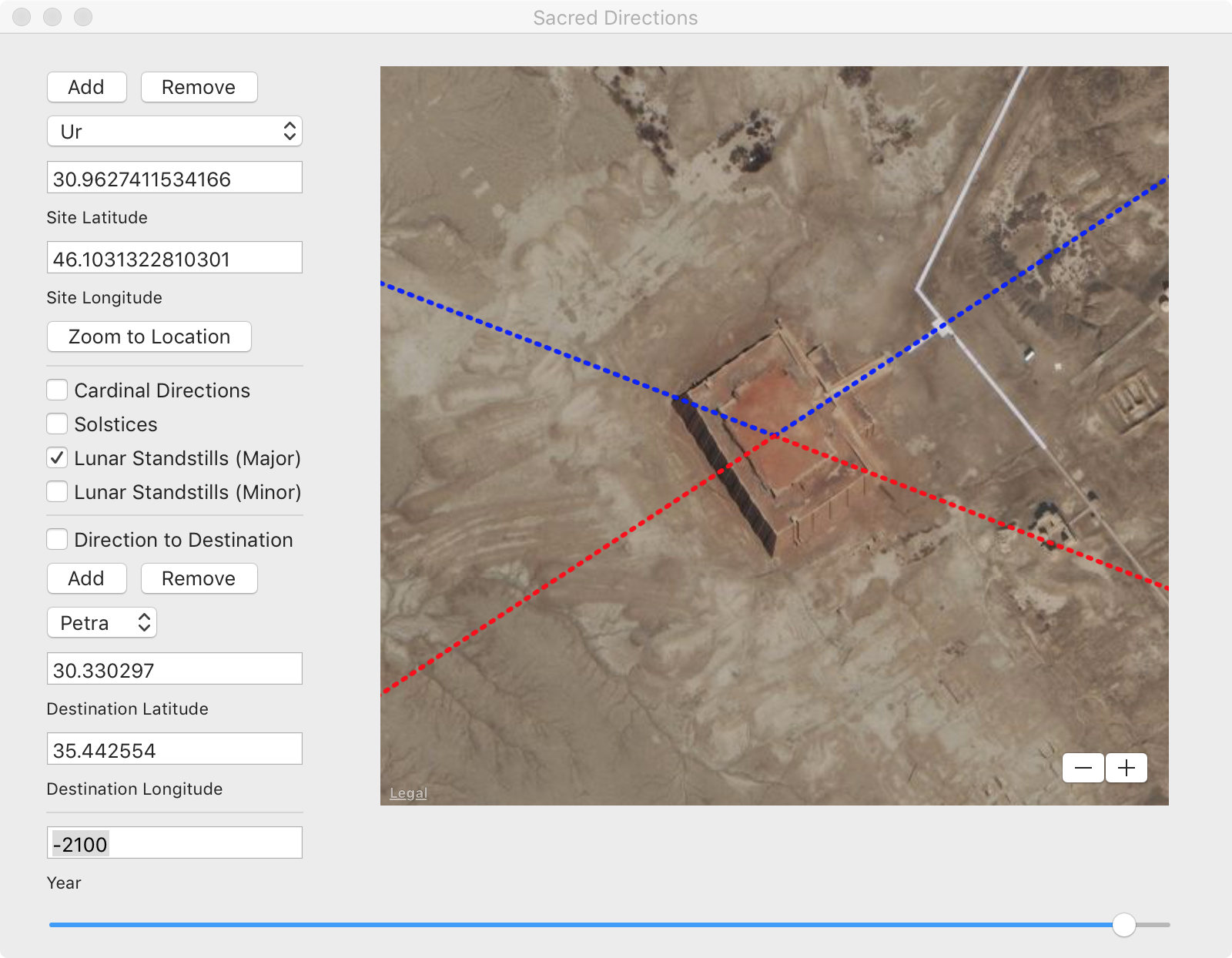
A little later in Mesopotamia King Ur-Nammu built a ziggurat dedicated to Nanna, the son of the two original Sumerian deities, Enlil and Ninlil. Nanna was the god of the moon and wisdom yet ironically the temple dedicated to him was called “Etemennigur,” which means “House whose foundation creates terror.” As shown in Figure 3 the Ziggurat of Ur is aligned in the direction of maximum northern major lunar moonrise and maximum southern major lunar moonset with best alignment achieved around the accepted time of construction, approximately 2100 BCE.

Figure 3 Alignment of the Ziggurat of Ur to major lunar standstills around 2100 BCE.

India

Few temples in India appear to be aligned to the moon. According to Sikh historical records, the land that became Amritsar was chosen by Guru Amar Das, the third Guru of the Sikh tradition. Arjan, the fifth Sikh guru, completed the Golden Temple in Amritsar in 1604. The overall layout of the site including the reflecting pools is consistent with the direction of minor lunar standstills. (Recall major standstills are the most northern and southern moonrises and moonsets and so minor standstills are the least northern and southern moonrises and moonsets.) What is unusual about the site is that the best alignment is achieved when the earth was at minimum obliquity, approximately 14,000 years ago (Figure 4). If the Golden Temple is aligned to the moon perhaps Amritsar had been an even earlier site of religious significance.

Figure 4 Alignment of the Golden Temple in Amritsar to minor lunar standstills.

Southeast Asia

Continuing east, the Khmer empire constructed monumental cities and religious sites in Cambodia around a thousand years ago. Where most places including Angkor Wat and Angkor Thom are aligned to the cardinal direction, others such as Preah Khan and Koh Ker are not.

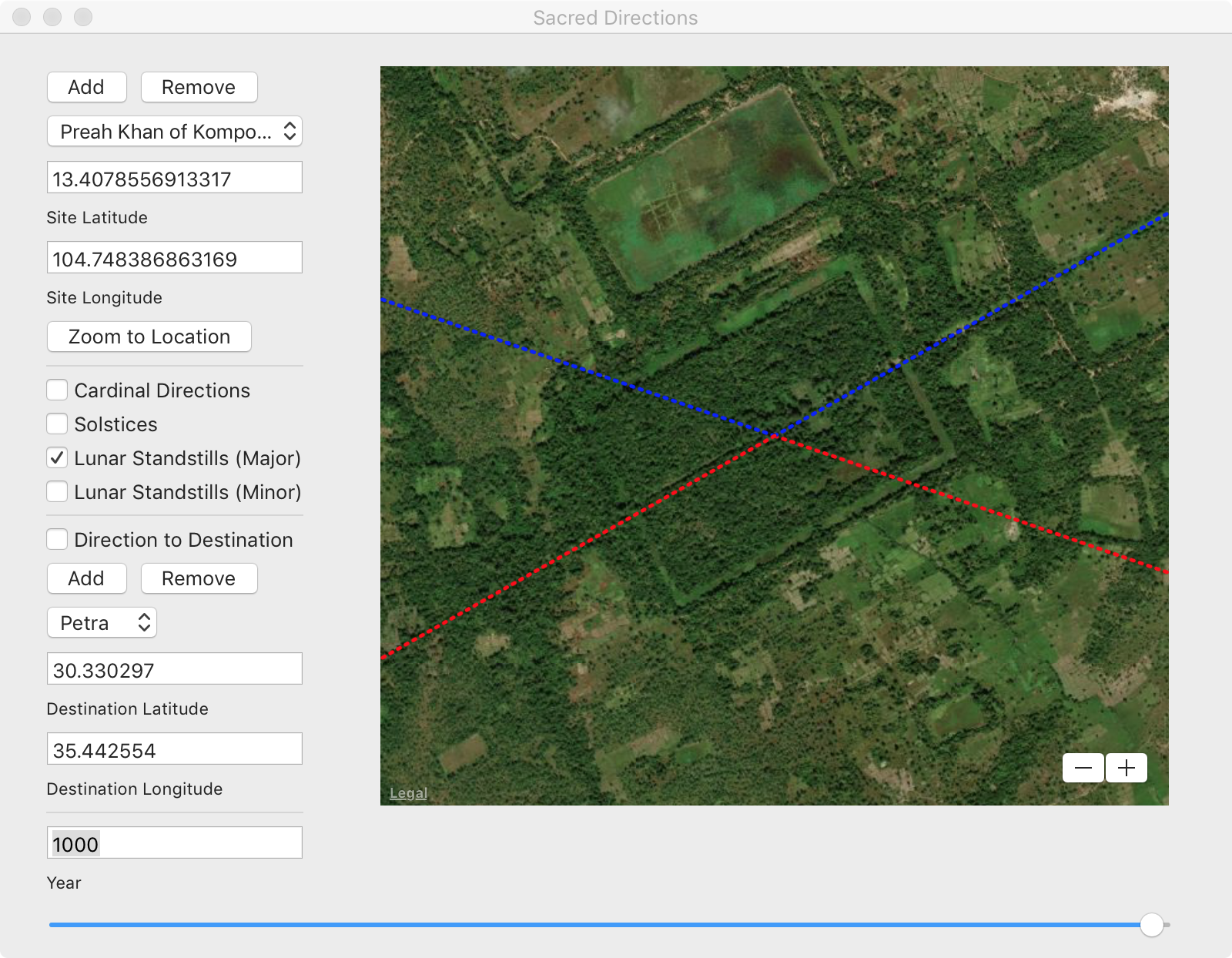
Preah Khan of Kompong Svay is approximately 100 km east of Angkor Wat. It consists of a series of four concentric rectangular enclosures that contain temples, buildings, and a central sanctuary. According to Giulio Magli the site is aligned to the moon, specifically to the northern major lunar standstill. Based on a single dated inscription, the site is thought to have been built around 1000 CE, which turns out to be consistent with the alignments in Figure 5.

Figure 5 Alignment of Preah Khan to major lunar standstills.

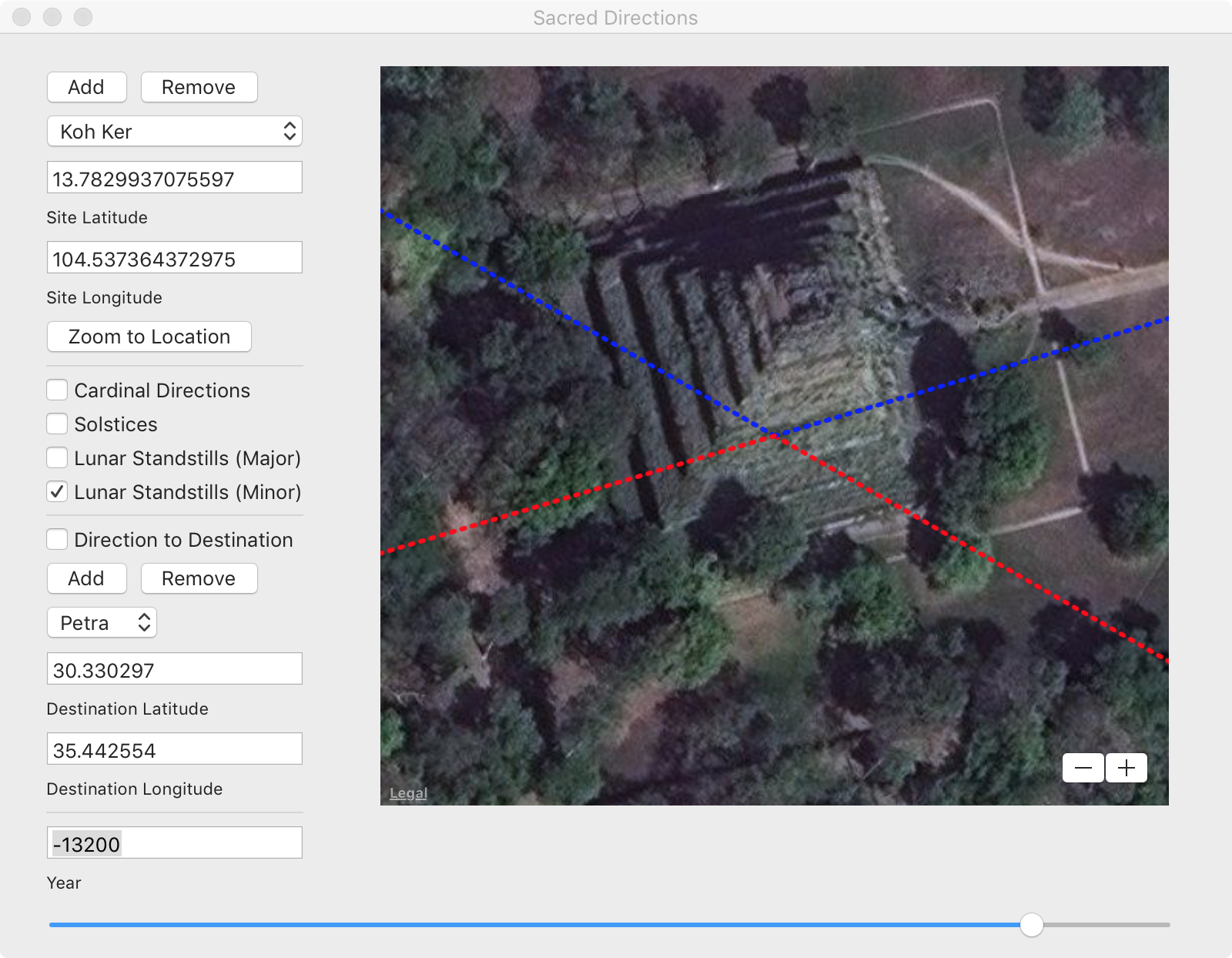
Koh Ker is 50 km north, northwest of Preah Khan. In the same paper referenced above, Magli argues that Koh Ker is aligned in the direction of sunrise on the day when the sun rises directly over the site (zenith passage). Figure 6 suggests another possibility – that the site was aligned to the northern minor lunar standstill approximately 15,000 years when the earth was near minimum obliquity.

Figure 6 Alignment of Koh Ker to minor lunar standstills.

Central America

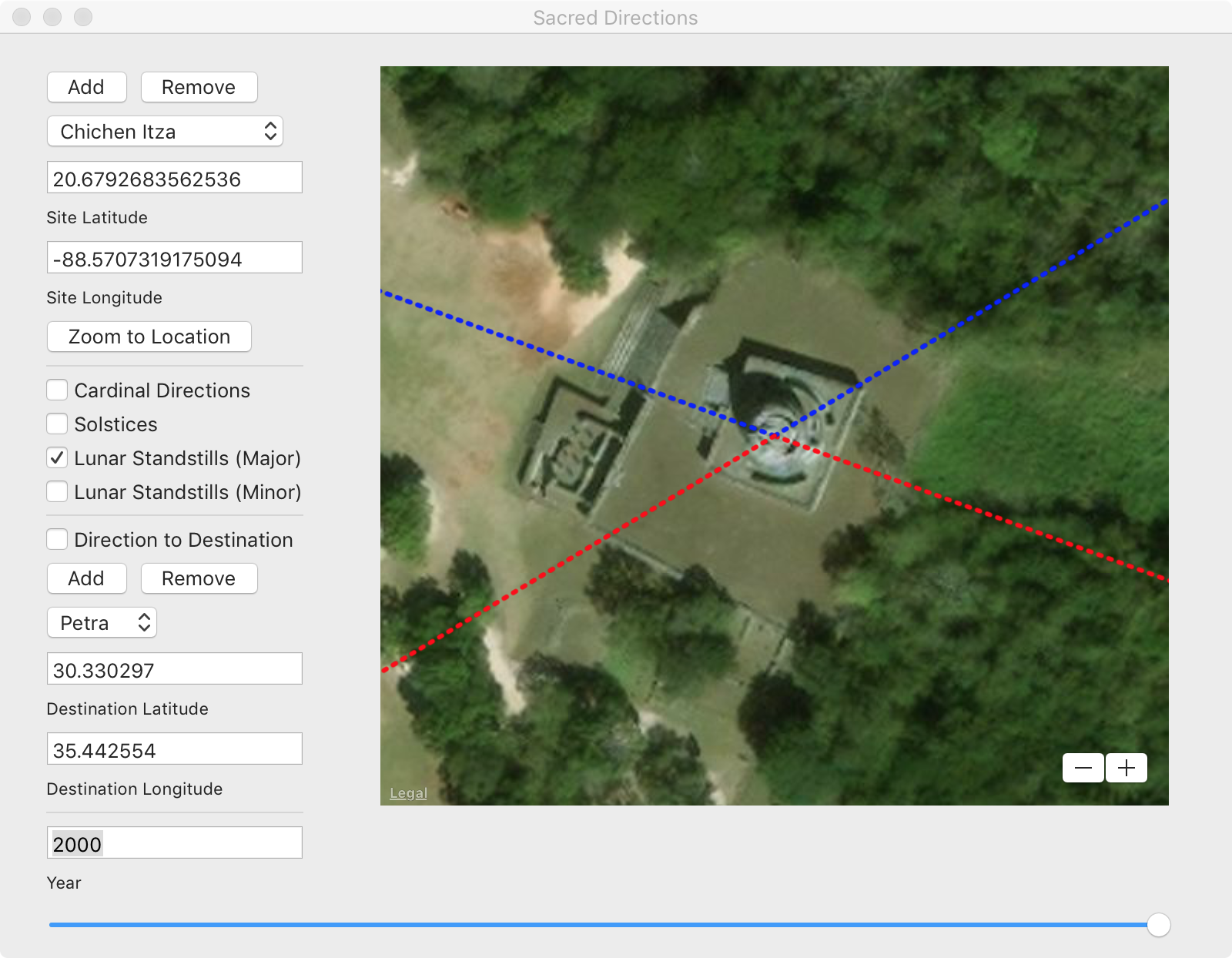
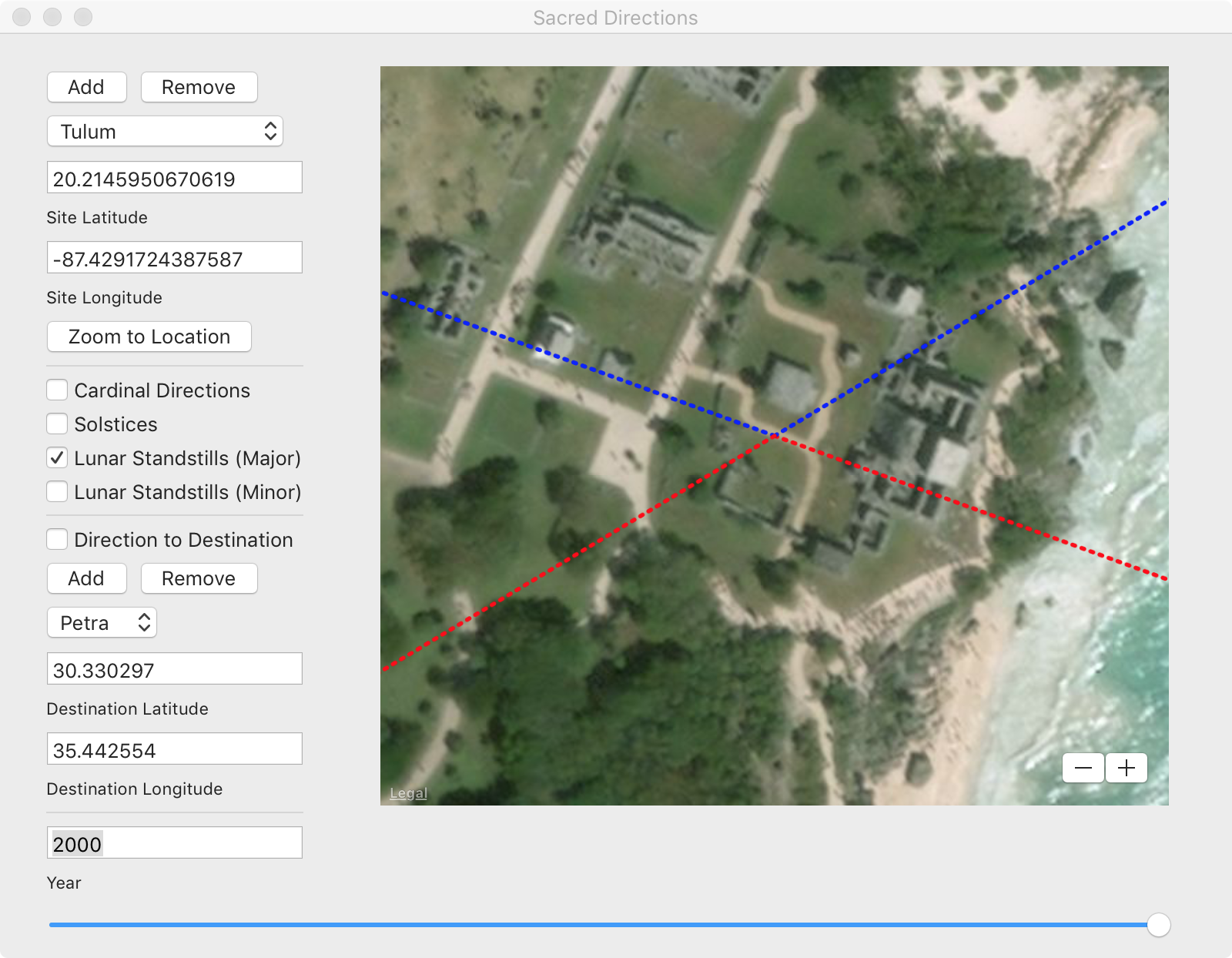
As discussed in Before Atlantis, Chichen Itza and Tulum are two sites in Mexico’s Yucatan Peninsula that might have been aligned to an earlier location of the North Pole in the Norway Sea. Many of the structures at Chichen Itza including the Caracol also appear aligned with major lunar standstills (Figure 7). The Caracol is believed to have been used as an observatory by the Maya who were familiar with the motions of the sun, moon, stars, and planets. The alignment of most structures at Tulum also appears to be aligned with major lunar standstills (Figure 8).

Figure 7 The Caracol at Chichen Itza is aligned to major lunar standstills.
Figure 8 Most structures at Tulum are aligned to major lunar standstills.

South America

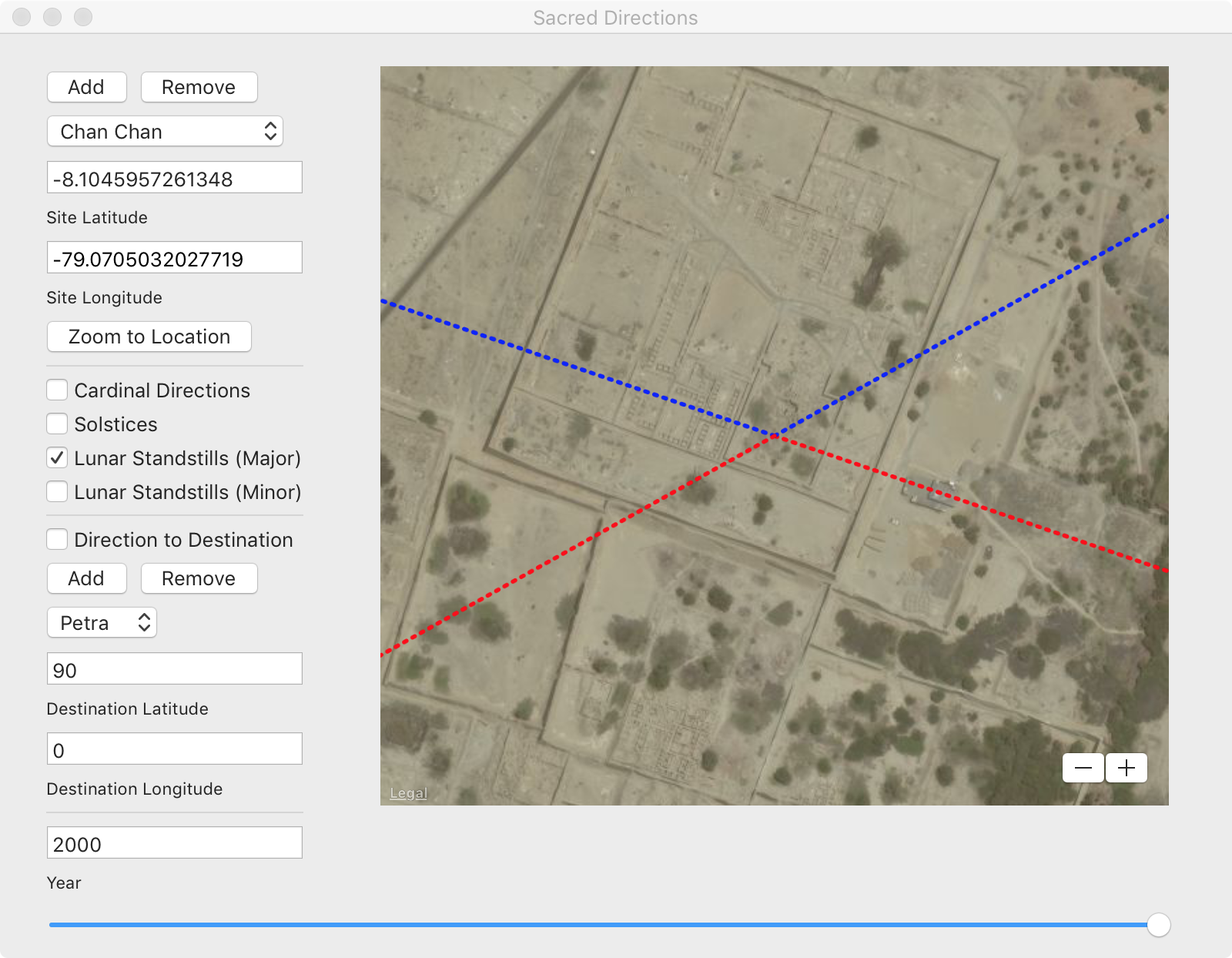
Located in Peru, Chan Chan is believed to have been built around 850 CE by the Chimu culture. The etymology of the name is thought to be derived from the Quingnam “Jiang” or “Chang” which means Sun. The name could also be derived from the term: “Shian” where “Shi” translates as Moon and “An” as house, meaning House of the Moon.

As discussed in Before Atlantis, the orientation of Chan Chan correlates both the direction of the Norway pole and to major lunar standstills. One explanation that satisfies both the solar and lunar interpretations of its name is that the original site was constructed long ago when the North Pole was in the Norway Sea and so was originally aligned to the cardinal directions and to the sun. Later it was co-opted by the Chimu, who repurposed Chan Chan as a lunar site as a result of its serendipitous realignment to the moon.

Figure 9 Part of an extended area in Chan Chan aligned to major lunar standstills.

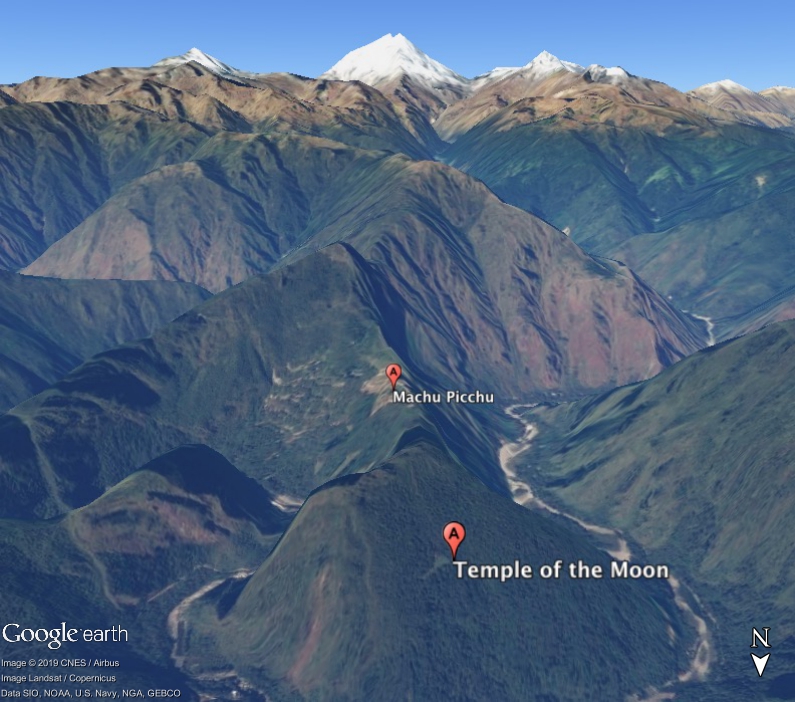
On a mountain top north of Machu Picchu lies a site called the Temple of the Moon that is built into an open-face, shallow cave. Like other places in Machu Picchu, the site is generally thought to have been arbitrarily named. Figure 10 shows the site in a Google Earth perspective view looking south.

Figure 10 View looking south from north of Huanya Picchu toward the Temple of the Moon.

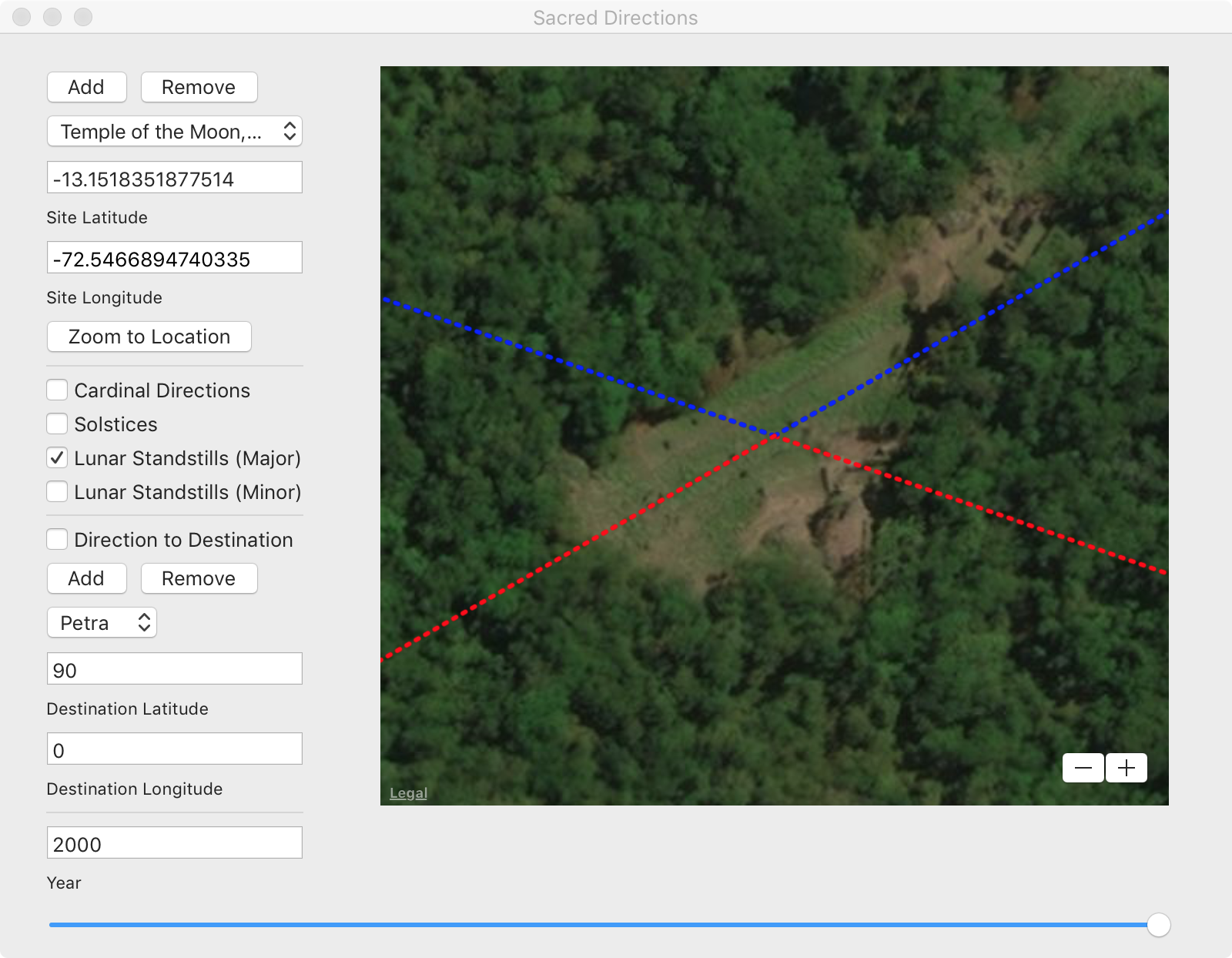
Being in the tropics south of the equator the sun moves north after sunrise at certain times of the year and south at other times. The moon also travels north after moonrise at certain times of the year as well. The cave opening faces north and spans the maximum possible northern range of lunar motion (Figure 11). That the cave was oriented in this direction for the purpose of observing the moon would seem to be no accident.

Figure 11 The Temple of the Moon faces north, which is not visible in the view. The blue dotted lines depict the full range of lunar motion visible from the cave opening.

North America

We complete our journey around the world in North America and examine two Native American sites that appear to be aligned to the moon.

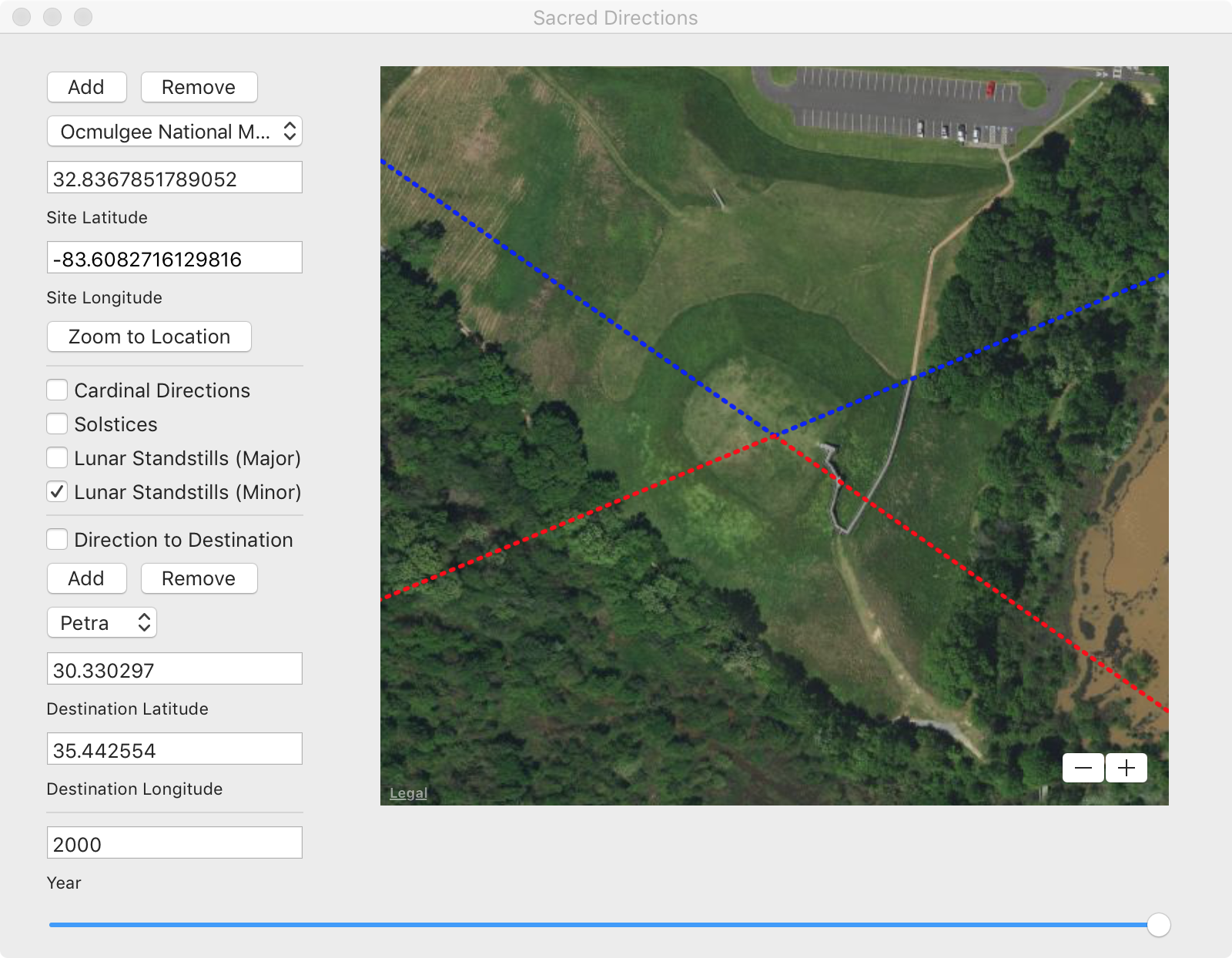
Ocmulgee Mounds National Historical Park in Georgia contains the remains of major earthworks built before 1000 CE by the South Appalachian Mississippian culture that includes the Great Temple Mound and other ceremonial mounds, a burial mound, and defensive trenches. Evidence suggests the site has been continuously occupied for 17,000 years. As shown in Figure 12 The Great Temple Mound appears to be aligned to the southern minor lunar standstill. The nearby Lesser Temple Mound also appears to be similarly aligned. Lunar alignments are thought to exist at Cahokia another Mississippian site in Illinois as well.

Figure 12 Alignment of the Great Temple Mound at Ocmulgee to minor lunar standstills.

Pueblo del Arroyo is an archaeological site in Chaco Canyon, New Mexico. The structure was a “great house” built in the latter part of the 11th Century by the Ancestral Puebloan or Anasazi people, who are thought to have built many structures in alignment with lunar and solar (seasonal) cycles. Given the flatness of the surrounding terrain, the location of the site would seem to take full advantage of its alignment to the southern maximum moonrise and northern maximum moonset (Figure 13).

Figure 13 Alignment of Pueblo del Arroyo in Chaco Canyon to major lunar standstills.

Summary

Numerous sites all over the world are aligned to the moon. Where the seasonal path of the sun is easily discernible, the complex motion of the moon, which repeats in 18.6-year cycles would have required dedicated observation over a much longer period of time. Although it is possible that the builders of these and other sites that are aligned to the moon did independently discern the complexity of lunar cycles it is also possible that this knowledge was inherited from an earlier people, perhaps from an unknown and highly advanced civilization that existed long ago. 

An Alternative SETI Strategy for the Moon

After decades of increasingly more detailed photoreconnaissance of the moon, we have yet to discover compelling evidence of alien objects or structures on the surface. Many features that at first attract our attention are at the limits of resolution or are viewed at unfamiliar sun angles or highly oblique look angles. Under different conditions or in higher resolution images, most turn out to be craters, rock outcrops, or other natural features. 

Carl Sagan was one of the first scientists to suggest the possibility of extraterrestrial activity on the moon. In the 1960s William Blair announced the discovery of “lunar spires” that turned out to be large boulders lit at a low sun angle casting long shadows that looked like towers. George Leonard and Fred Steckling believed they had found extensive evidence of alien activity on the moon, which they described in their books Somebody Else is on the Moon and We Discovered Alien Bases on the Moon. Richard Hoagland argued that there were enormous towers and glass structures visible in Lunar Orbiter and Apollo photography. Attempts to locate these features, in particular, one known as “the shard”, were not successful.

In a previous post, we searched for evidence of a “monolith” that the Soviet Union claimed their Lunokhod 2 rover had found, photographed, and analyzed in 1973. Other possible structures purported to have been found on the moon have been investigated and determined to be optical illusions. One was a tower on the edge of the crater Lobachevsky first spotted by Johannes Fiebag. Higher resolution imagery revealed that the impression of a tower was created by a pattern of dark crater ejecta material and a reflection off the rim of the crater. Another was what appeared to be a bridge at the edge of the Sea of Crisis that turned out to be an optical illusion caused by the interplay of shadows.

Lunar Archaeology

In 1990 a colleague of mine and I first proposed the idea of using anomaly detection algorithms to search for artificial objects on planetary surfaces. Alexey Arkhipov described several such algorithms and provided a listing of more than a hundred “finds” or anomalies detected on the moon in Clementine imagery. Arkhipov’s paper “Towards Lunar Archaeology” is a blueprint for lunar SETI:

“Our Moon is a potential indicator of a possible alien presence near the Earth at some time during the past 4 billion years. To ascertain the presence of alien artifacts, a survey for ruin- like formations on the Moon has been carried out as a precursor to lunar archaeology. Computer algorithms for semi-automatic, archaeological photo-reconnaissance are discussed. About 80,000 Clementine lunar orbital images have been processed, and a number of quasi-rectangular patterns found. Morphological analysis of these patterns leads to possible reconstructions of their evolution in terms of erosion. Two scenarios are considered: 1) the collapse of subsurface quasi-rectangular systems of caverns, and 2) the erosion of hills with quasi-rectangular lattices of lineaments. We also note the presence of embankment-like, quadrangular, hollow hills with rectangular depressions nearby. Tectonic (geologic) interpretations of these features are considered. The similarity of these patterns to terrestrial archaeological sites and proposed lunar base concepts suggest the need for further study and future in situ exploration.”

Some of the rectangular features Arkhipov discusses appear to be related to patterns on the lunar surface known as the lunar grid, which was explored by Fielder and others.

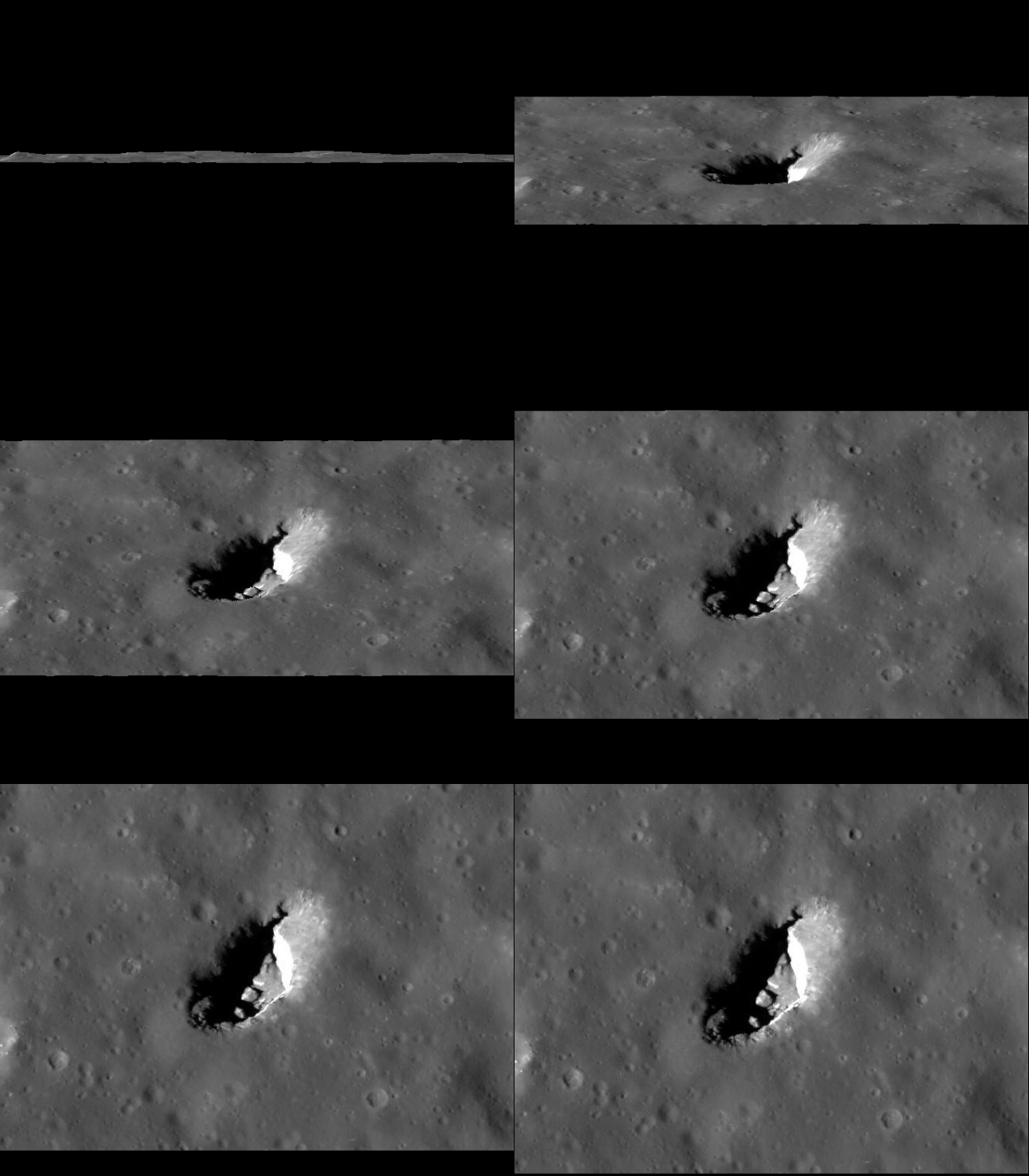
Lacking evidence of ET activity on the surface leads to the question of whether or not there might be activity underground. In 2017 Ananda Sirisena, Fran Ridge, and I showed that certain features first imaged by Apollo in the crater Paracelsus C on the far side of the moon are present in more recent Lunar Reconnaissance Orbiter (LRO) imagery and appear even more remarkable up close. 3-D analysis suggests that one of the features may be an opening leading underground.

Lava Tubes

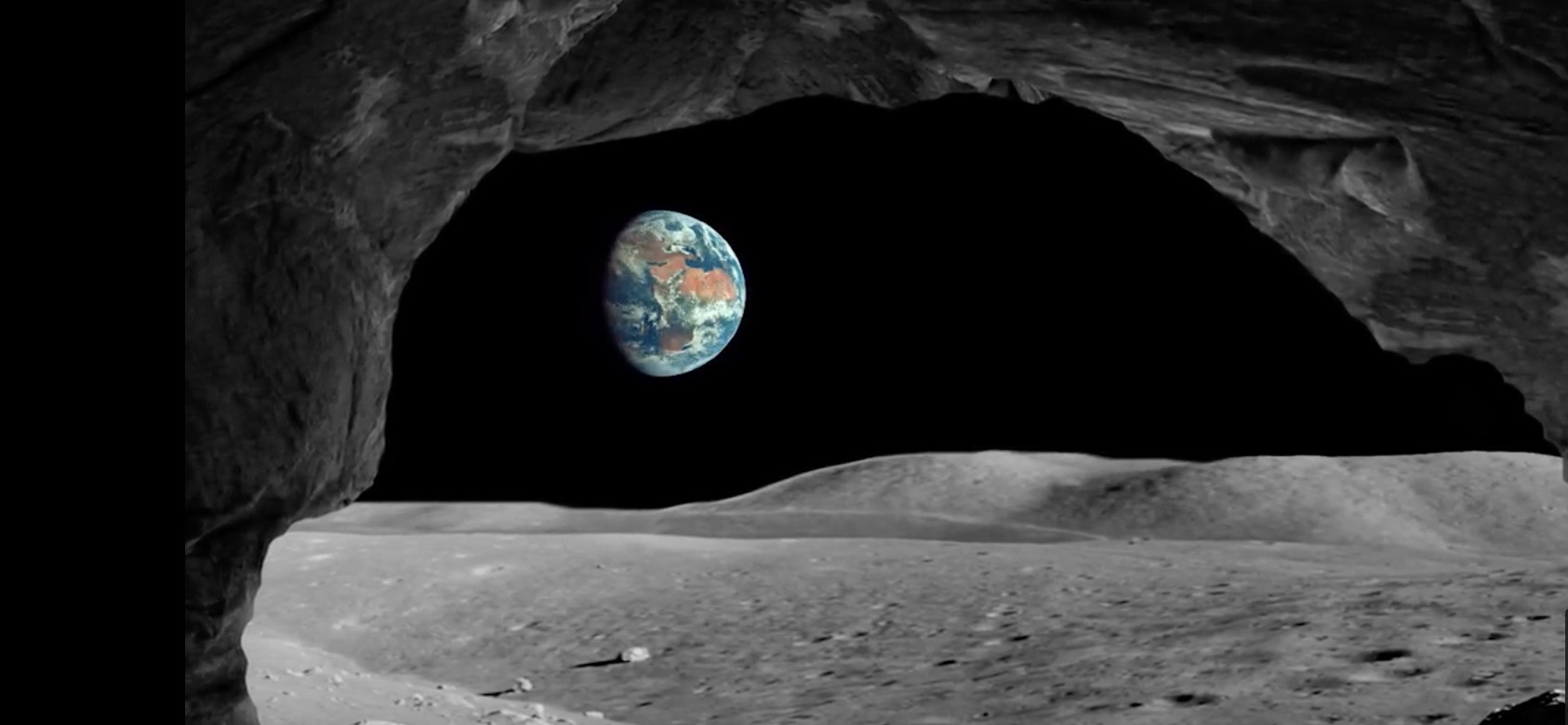
The idea of underground lunar settlements or bases is gaining support after the discovery of lava tubes on the moon by the Japanese Kaguya spacecraft in 2008. It appears that many long sinuous features on the moon called rilles are collapsed lava tubes. The existence of a lava tube is sometimes revealed by the presence of a “skylight,” a place in which the roof of the tube has collapsed, leaving a circular hole.

LRO has found hundreds of skylights. The Chandrayaan-1 orbiter imaged a lunar rille with an uncollapsed segment suggesting the presence of a lava tube near the lunar equator. Gravitometric observations by the GRAIL spacecraft suggest the presence of lunar lava tubes with widths of over 1 km. 

Large underground spaces the size of cities are possible. Assuming a width-to-height ratio of 3:1, a structure can remain stable with a ceiling that is 2 m thick. Lava tubes at least 500 m underground can theoretically remain stable with widths of up to 5 km.

Transient Lunar Phenomena

For hundreds of years, astronomers have noticed strange features on the lunar surface. The first recorded sighting was a star-like point of light on the dark side in 1540. Other features that have been reported include small whitish clouds by Cassini in 1671, ‘lightning’ by Louville and Halley in 1715, ‘vapors’ by Schroter and Olber in 1797, brilliant flashing spots on the dark side by Gruithuisen in 1821, dots and streaks of light by Slack and Ingall in 1869, a glow of light in the crater Plato by Fauth in 1907, a moving luminous speck near Gassendi by Haas in 1941, a pulsating spot on dark side by Emanuel and others in 1965, and hundreds more. In 1968, NASA published a compendium of these so-called lunar transient phenomena (LTP) sightings in a report entitled, Chronological Catalog of Reported Lunar Events.

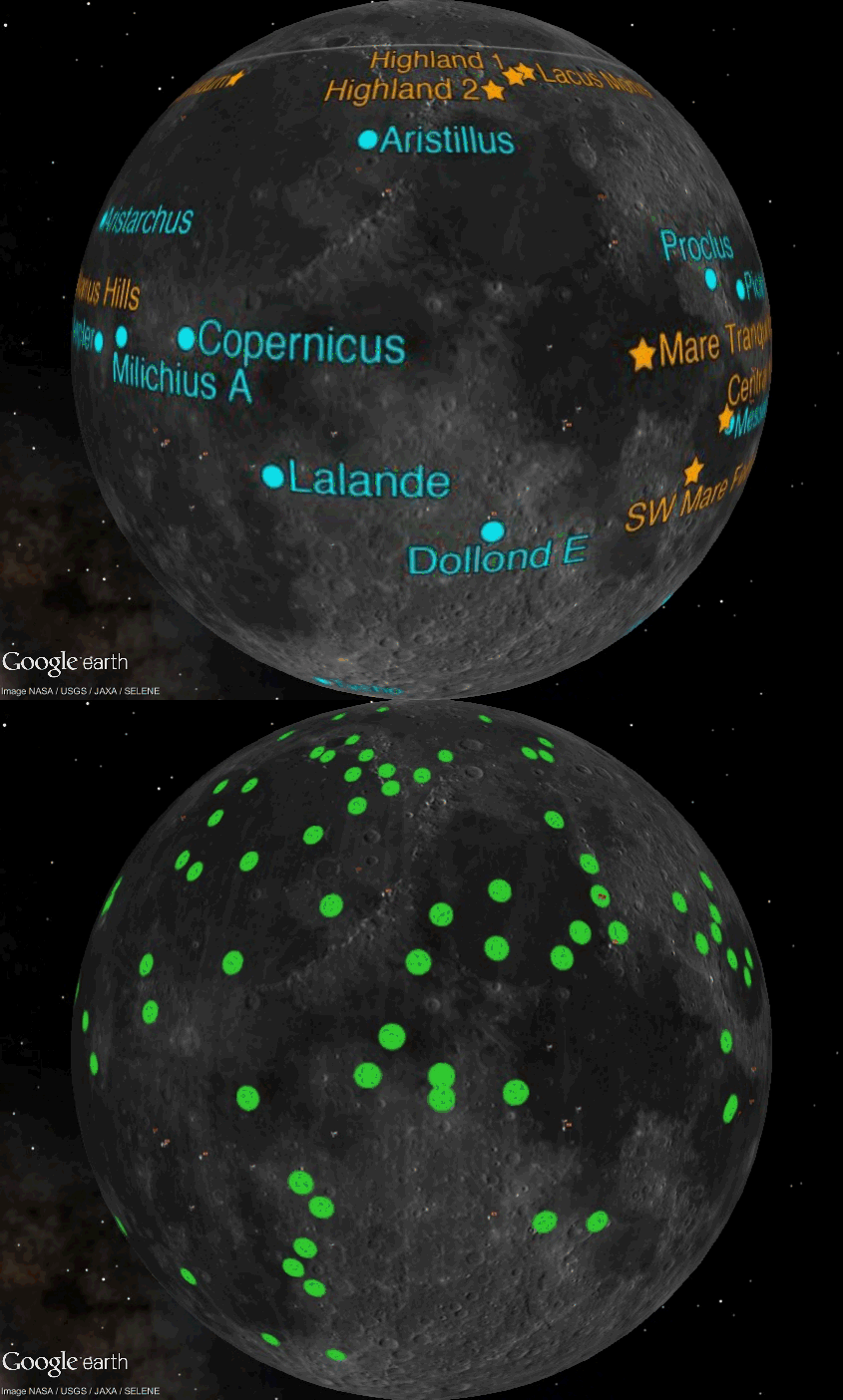
A majority of TLP events occur near the maria, which is where many lava tubes are located. Could there be a spatial correlation between TLP events and skylights? 

Correlation of TLP events (green dots) with locations of skylights. 

If there were underground bases on the moon that were accessed through skylights one possible alternative SETI strategy might be to image skylights continuously, or at least as frequently as possible, to attempt to detect such activities.

Thermal Anomaly Detection

One of the instruments aboard LRO is the Diviner Lunar Radiometer that has mapped the global thermal state of the Moon and its diurnal and seasonal variability. If there is an active presence below the surface of the moon it is likely generating heat. Another alternative SETI strategy finds underground activity on the moon using thermal imagery. By correlating optical and thermal imagery it is possible to detect thermal anomalies – areas in an image that are different from the natural background that could be indicative of underground heat sources.

Summary

NASA’s recent technosignatures report proposes a new approach to SETI based on advanced technologies, future sensor capabilities, and crowdsourcing. Unfortunately, the report reads much the same way as previous SETI strategies that can be characterized as a search for ETs either a long time ago, or in a galaxy far, far away.

That reports of TLP and related events have persisted for hundreds of years suggests a more exciting and potentially more relevant strategy to look for signs of an extant intelligence underground. The benefit of this strategy is that even if we don’t find alien bases we might, in the process, find some good places to build our own.

Feature image courtesy V101 Science.

In Search of the Lunokhod “Monolith”

In this article, we digress from our investigation of ancient mysteries on Earth to examine an unresolved mystery on the moon. 

Half a century ago Apollo landed the first men on the moon. A few years later the Soviet Union continued their unmanned exploration program with the landing of the Luna 21/Lunokhod 2 spacecraft in the crater Le Monnier. A month later, on Thursday, February 15, 1973, the Soviet news agency Tass reported that the Lunokhod 2 was investigating “an unusual piece of lunar material.” The report stated that a “one-meter long plate, resembling a modern house panel, has proven to be a strong monolith” and goes on to describe the plate as having “a smooth surface.”  An article in the January-February 1973 issue of the  ARPO Bulletin contained excerpts from a story in the February 19 issue of Soviet Aerospace:

“The article [in Soviet Aerospace] stated that the ‘stone plate which has so puzzled scientists’ has a smooth surface which is unlike the large stones in the area and that it withstood ‘the buggy’s pressure of a hundred atmospheres’ (1,407 lb. per square inch) which left only slight traces on the thin layer of dust which covered the plate. Also, the article said, scientists have determined that the plate ‘seems much younger’ than other stone material in the area.”

“Because of the monolith’s uniqueness, scientists decided to continue to investigate it to determine its chemical composition and magnetic properties, as well as transmit TV photos. The object was found on February 13 and plans were made to continue the investigation through the 16th. The bedrock in the immediate area was described as being different from the material observed and tested earlier and because the monolith is also so different from the surrounding bedrock the scientists were wondering if such a combination is accidental.”

News of this discovery was also reported by NASA:

“A monolith one meter (three feet) long of unusual lunar material was discovered Feb. 13. The plate had a strong, smooth surface unlike surrounding pockmarked stones and appeared to be much younger.”

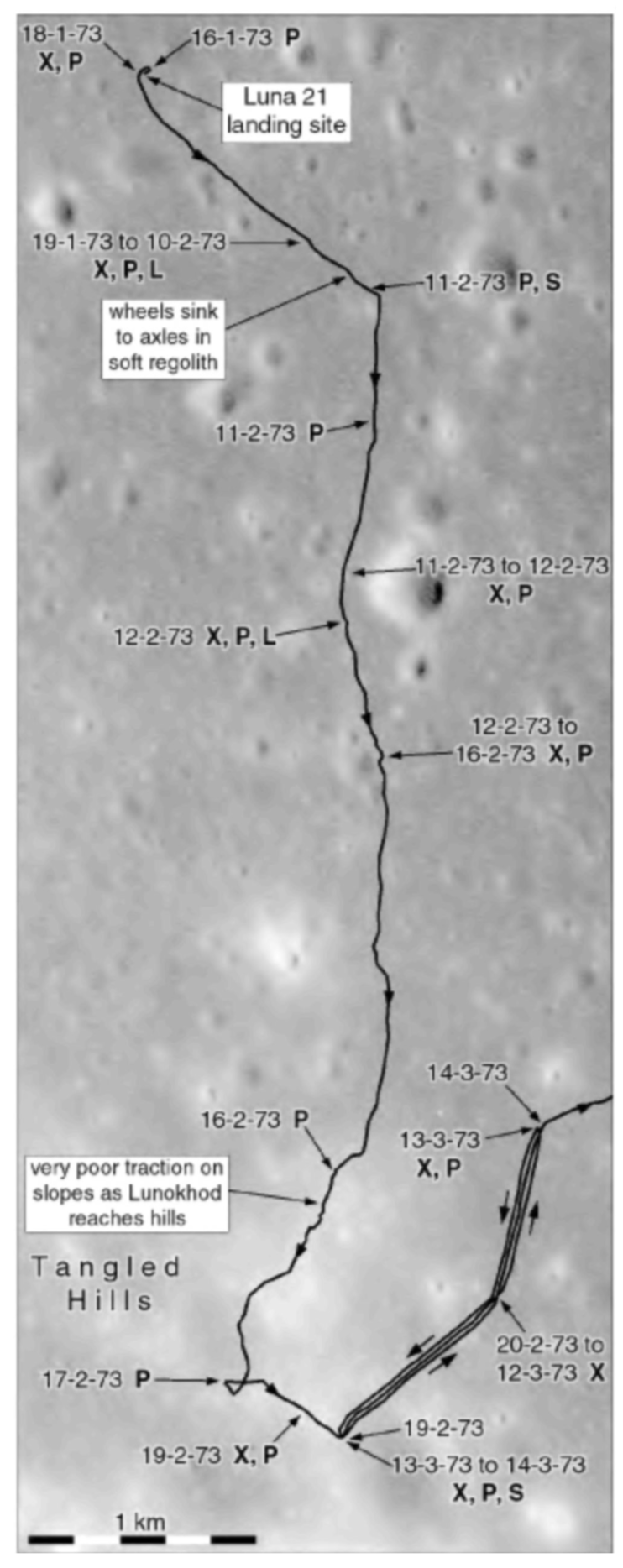
Figure 1 Western section of Lunokhod 2 route. From Stooke (2009). Click on image for full resolution view.

Figure 1 summarizes the first three months of the probe’s operation on the moon. According to Phillip Stooke in the International Atlas of Lunar Exploration

“From 12 to 16 February the rover parked near a large fresh boulder as the high Sun made visibility difficult. The rover then drove rapidly south to the nearby hills where it took new panoramic images and performed experiments.”

This is when, according to both the Tass and Soviet Aerospace stories, the rover was analyzing and taking photos of the monolith. The location of the rover over this period of time is marked in the figure with the label “12-2-73 to 16-2-73 X, P” where “X” and “P” indicate that x-ray fluorescence spectrometer measurements and panoramic photographs were taken, presumably after the rover had left the shade of the boulder and traveled south.

The Laboratory for Comparative Planetology website lists 92 pan photos captured in 44 sessions. The map in Figure 1 plus three other maps depicting the later movement of the rover show 26 locations where photos were taken. Stooke states that the map does not list all of the panoramas. It is also not clear if the website includes all of the photos that were taken.

Most of the panoramas show rolling, relatively featureless terrain. Figure 2 shows one of the photos taken during the second month (lunation) of lunar operations. Notice the angular rock in the center of the photo. The length of its shadow indicates the picture was taken late in the day, not around noon, when the rover was said to have been parked next to the large boulder. Other than Figure 2, none of the photos shows anything resembling a slab, let alone a monolith.

Figure 2 Lunokhod 2. Lunation 2. Session 14. Panorama 34. From Laboratory for Comparative Planetology. Click on image to enlarge.

If this rock encountered by the Lunokhod rover was so extraordinary why is there no photo of it? Was the announcement by Tass simply propaganda – an attempt to match the accomplishments of the US Apollo program? Or did the Soviets discover something remarkable on the moon, so remarkable that the photos and scientific data were withheld from their own scientists and the international community?

Where on the Moon?

After exhausting the available historical data we have reached a dead end. Still, it might be possible to use this information in conjunction with current imagery to search for the monolith using future probes.  The Lunar Reconnaissance Orbiter has imaged numerous manned and unmanned spacecraft on the lunar surface including the Luna 21 lander (Figure 3).

Figure 3 Landing site is the bright area near the top of the image. Note track leading south (top to bottom). Click for full resolution view. NASA/ASU

The tracks left by the rover are also visible over much of the terrain, which can be viewed using ASU’s Quickmap viewer.  By correlating Figure 1 with LRO imagery we can determine the general area where the rover was parked from February 12-16. An area around 25.87°N 30.45° E is shown in Figure 4. This location, somewhat less than three miles from the landing site, is near several unusual rectangular craters but appears otherwise unremarkable.

Figure 4 Search area for the monolith. The Lunokhod 2 track runs top to bottom in the middle of the image. Click on image for full resolution view. NASA/ASU

Although it is not possible to image an object only a meter long from lunar orbit, it may be possible one day to revisit this area on the moon, now that we know where it is, and rediscover what Lunokhod might have found almost a half-century ago.

The author would like to thank Rick Sterling, Fran Ridge, and Ananda Sirisena for their contributions.

Top image from the move 2001: A Space Odyssey.